What hail damage actually looks like
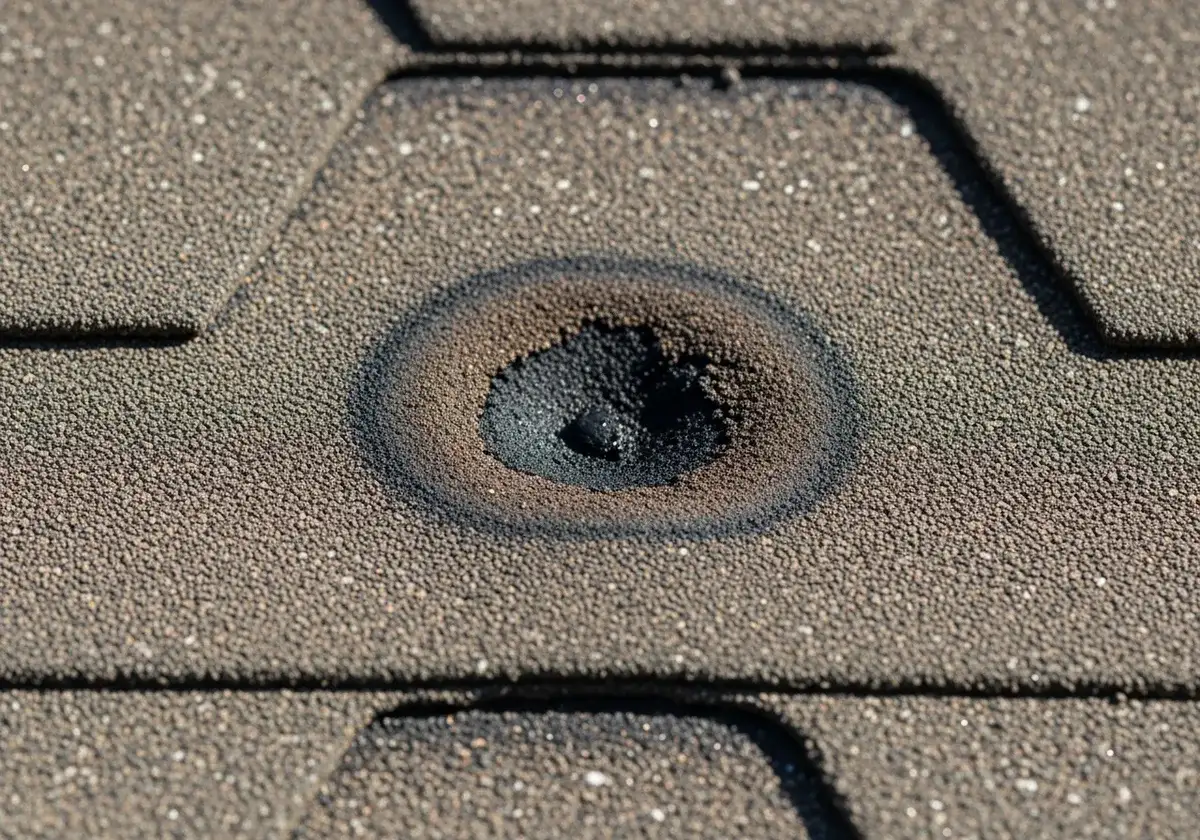
Real hail damage on asphalt shingles produces 'bruises' — roughly circular, coin- to quarter-sized dark spots where the impact crushed the surface granules into the asphalt mat below. The bruise reads darker than the surrounding shingle because the light-colored granules that normally reflect sunlight are gone, and the black asphalt underneath is now exposed or close to it. A fresh bruise can be subtle: a shallow depression you'd walk right past unless you were looking for it. There's a second tell that photographs badly but is obvious in person — press a thumb gently on a suspected bruise and it often feels soft and slightly spongy compared with the shingle around it, the way a bruised apple does, because the impact fractured the fiberglass mat under the surface. That combination, a dark circular mark that gives slightly under pressure, is the thing roofers are actually looking for. And it is the core problem with hail damage as a category: it is functional damage (the shingle's UV protection is compromised at that spot, and it will typically shed the rest of its granules there over the following one to three years, then crack) that looks, from a distance, like nothing at all.
Cosmetic vs. functional damage — why the distinction exists
Insurance policies and adjusters draw a line between cosmetic damage, which changes how the roof looks but not how long it lasts, and functional damage, which shortens the roof's useful life or lets water in. A real hail bruise is functional damage even when it hasn't visibly cracked yet, because the granule loss at that spot accelerates UV breakdown of the asphalt underneath it. Carriers don't always see it that way in the moment — some apply a 'cosmetic damage' exclusion or push back on hail claims that don't yet show a leak. The practical point is that not every mark on a shingle is hail, and knowing the difference up front saves you from either under-claiming real damage or over-claiming normal wear. What's usually NOT hail damage:
- Granule loss in random, isolated, speckled patches with no circular shape — this is normal wear, not impact
- Streaking in vertical or diagonal lines where granules wash off over years — that's UV/age wear or algae, not hail
- Long straight splits running with the length of a shingle, with no impact mark at either end — most often thermal splitting, where years of daily expansion and contraction finally tear the mat. Worth a roofer's eye anyway, because a shingle bruised by hail can crack later along the weakened spot and look much the same
- Dark green or black streaks — algae growth, a biological and cosmetic issue
Where to look first
Hail doesn't hit every slope of a roof equally — it falls at an angle driven by the storm's wind, so the slopes facing the storm take most of the impact and other slopes can look nearly untouched. In hail-prone regions of the central US, many damaging storms move in from the southwest, which is a reasonable starting point but not a rule for your specific storm — check every slope rather than assuming. Work through this order:
- Soft metal first — gutters, downspouts, AC condenser fins, mailbox, exposed vent caps and flashing
- Soft metal dents before shingles visibly bruise, so dimples there are a strong signal to keep looking even if the roof looks fine from the ground
- The slope(s) that faced the storm, if you know or can guess the wind direction
- Open slopes without overhanging tree cover, which take a fuller hit than sheltered ones
- Ridge cap shingles — often the hardest-hit because they sit at the highest point of the roof
The chalk-circle method
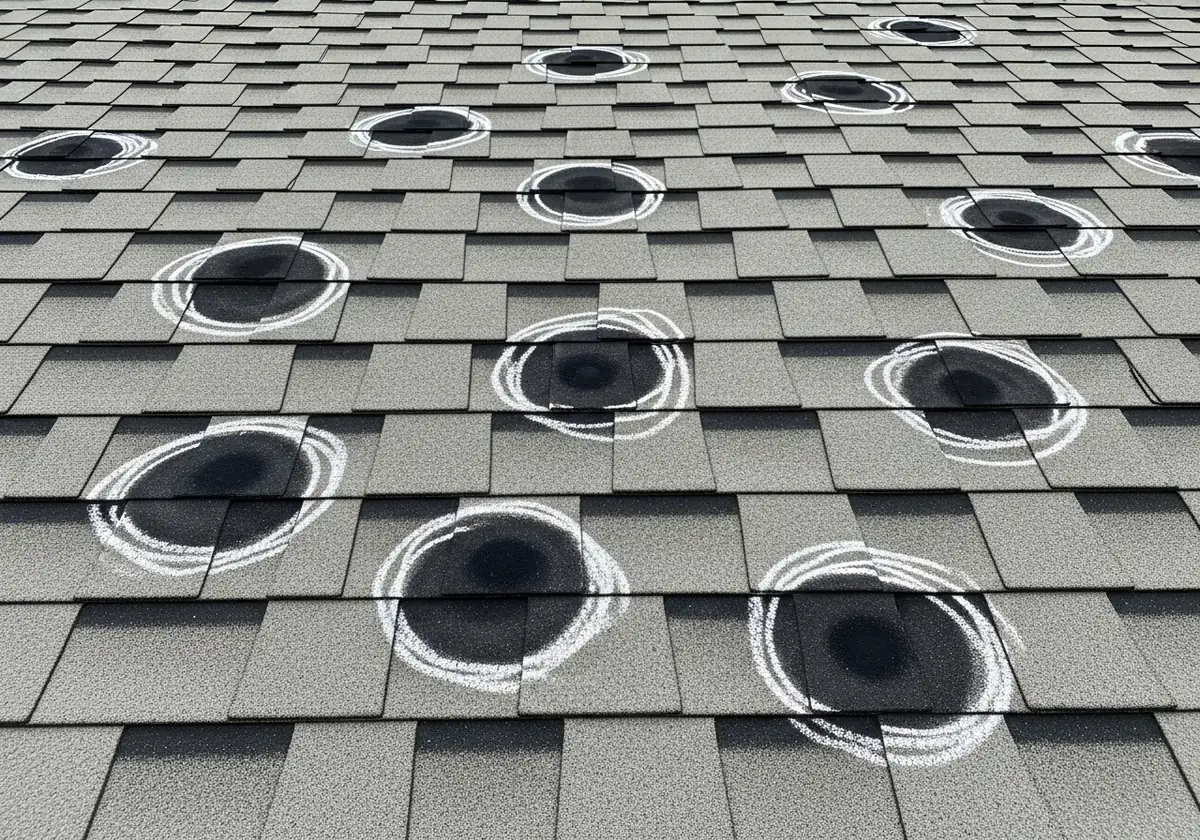
This is a common technique roofing consultants and many adjusters use to standardize what would otherwise be a subjective call. After spotting a suspected bruise, they lightly mark a chalk circle around it, then count bruises inside a 10-by-10-foot 'test square' on a representative section of each slope. There is no single industry-wide number — carriers and inspectors vary — but a density of roughly 8 or more bruises in one test square on at least one slope is a common working threshold that suggests widespread, claim-worthy impact rather than a few stray hits. If you can't safely access the roof yourself, a roofer will often do this for free in exchange for the chance to bid on the eventual repair or replacement work, so there's rarely a reason to skip the step out of cost concern.
When to look, and why the second look matters
Timing changes what you can see, in both directions. In the first day or two after a storm the surface evidence is at its freshest — loose granules still sitting in the gutter outlet and at the bottom of downspouts, splatter marks not yet washed off, the storm date unambiguous. But the bruises themselves are at their least visible then, because the granules over them have been crushed rather than shed. Over the following weeks and months, weather works those loosened granules off and the bruise darkens and widens into something you can actually pick out from a few feet away. That means an inspection right after the storm and a second look a month or two later are answering slightly different questions, and a 'nothing obvious' verdict from the first one is not the same as a clean bill of health. If you had a significant hailstorm and saw nothing, put a reminder in your calendar and look again — while noting that on most policies the clock started running on the day of the storm, not the day you found the damage.
The evidence that isn't on the roof
Adjusters look at the whole property, not just the roof, because the ground-level evidence is easier to date and harder to argue with. Most of it is visible in a ten-minute walk around the house, and any of it is a reason to get the roof looked at properly:
- Splatter marks — clean, light-colored circles on a dusty deck board, a painted fence rail, or a concrete step, where a hailstone washed the surface. They fade within a few weeks, which is exactly why they're worth photographing early
- Dented or torn window and door screens, and dimples in the thin metal of a garage door panel
- Bruised or shredded leaves under trees, and shattered stems on garden plants, all on the same side of the house
- A pile of loose granules where the downspout empties, or a gritty line along the gutter's low end, well beyond the trace amount a roof normally sheds
- Chipped or gouged paint on the storm-facing wall, window sills, and any wooden trim
- Dings in a vehicle parked in the open at the time — the single most persuasive piece of collateral evidence there is, because nobody argues about what dents a car hood
What to do if you find damage
Once you've found signs that look like real hail damage, the sequence that protects your claim is roughly this. None of these steps costs money up front, and skipping straight to a phone call with your carrier before you've photographed and measured anything is the most common way homeowners under-document a claim that later gets scoped down.
- Photograph everything: dated and timestamped where possible, multiple angles, both close-up on individual bruises and a wider shot for context
- Pull a free RoofTap report so you have roof measurements ready before an adjuster arrives
- Check the NOAA Storm Events Database — or use RoofTap's free hail-report-by-address tool, which checks NOAA/NWS storm reports within a 10-mile radius over the past 12 months — to confirm a hail event actually hit your area and get a date to point to
- Contact your insurance carrier to start a claim; be as specific as you can about the storm date
- Get a licensed roofer to do a full inspection and provide a written, itemized estimate
- Be present when the adjuster visits if you can, with your photos and the contractor's estimate on hand
Quick reference: is what you found actually hail damage?
Not every mark on a roof is storm damage, and not every storm mark is a strong claim. This is a starting point, not a verdict — a licensed roofer's inspection is what actually settles it.
| What you found | Likely cause | Claimable? | What to do next |
|---|---|---|---|
| Dark, roughly circular spots scattered across a slope | Hail bruising | Usually, if density and a storm date line up | Run the chalk-circle count; if dense, call your carrier |
| Dimpled gutters, downspouts or AC fins, shingles look fine | Hail impact the shingles absorbed without an obvious mark | Possibly — worth a closer look | Book a roofer to inspect the shingles directly before assuming they're fine |
| Missing shingles, or lifted and creased tabs | Wind, not hail | Often, as wind damage | Photograph the broken seal line, then file it as part of the same storm claim |
| Speckled, random granule loss with no circular pattern | Ordinary wear and UV aging | Rarely | Not usually worth filing; note it for your next roof inspection |
| Dark streaking running in vertical lines | Algae growth | No | Cosmetic — not a storm-damage claim |
| Long straight splits along a shingle, no impact mark | Most often thermal splitting from age and temperature cycling | Sometimes — a hail-bruised shingle can crack later and look identical | Get a roofer to check the split for an impact mark before you rule out a claim |