When to file (almost always yes)
This is a starting checklist, not a substitute for reading your own policy — but if you're weighing whether to pick up the phone, file the claim if any of these apply to what you've found:
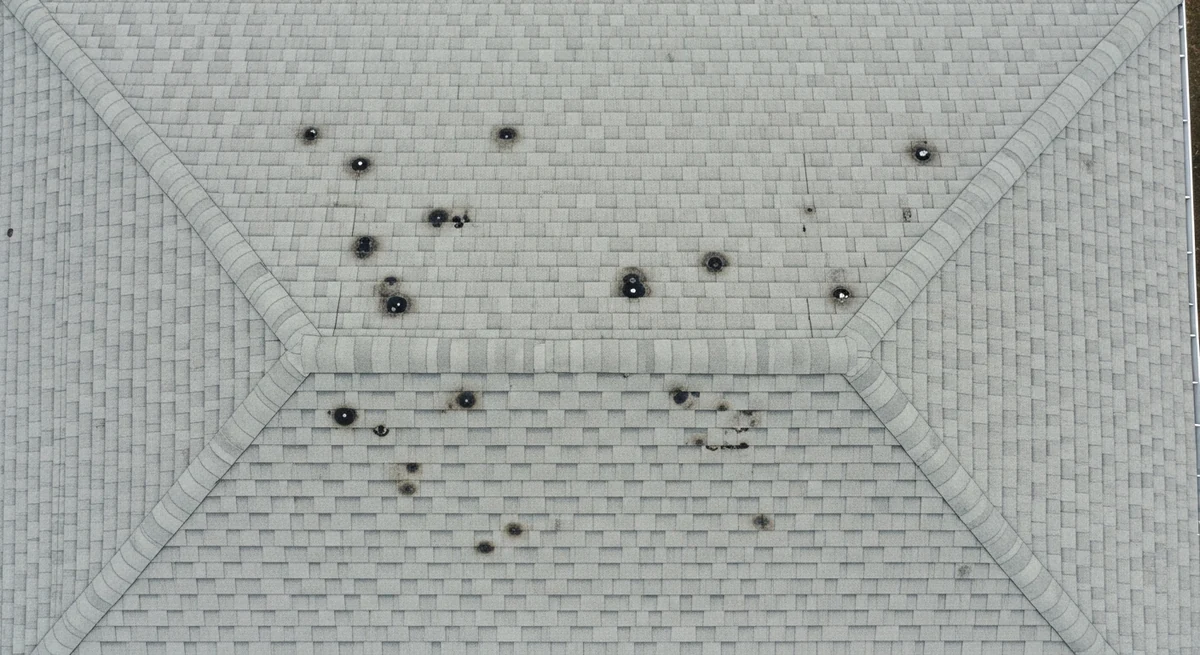
- Multiple slopes show hail damage at a density that clears a working test-square threshold — commonly around 8 bruises in a 10-by-10-foot square, though carriers vary
- More than a handful of shingles are missing, creased, or lifted from wind
- An interior leak is active, or you can see water staining on the ceiling or attic
- Soft-metal damage is widespread — gutters, AC fins, and vent caps all showing dents
- A contractor's repair estimate comes in well above your deductible, roughly double or more
- A documented storm event — NOAA-confirmed hail or a severe storm report — actually hit your zip code
When not to file
Consider paying out of pocket instead if:
- The damage is localized to a small section and the repair estimate is close to or below your deductible
- Your roof is under about 5 years old and the damage found is cosmetic only
- You've already filed two or more weather claims in the past 3 years — carrier appetite for a third varies and can trigger a non-renewal review in some markets
- There's no storm event you can point to, and the likely outcome is a 'wear and tear' denial regardless of how the claim is written
The deductible math
Run this before you call anyone. Get a written contractor estimate, then subtract your deductible from it — that's roughly what you'd actually net from the claim, before considering how a claim on your record might affect future renewal or pricing. The numbers below are illustrative only, not a quote for your situation; run your own contractor estimate against your actual deductible from your declarations page.
| Repair estimate | Your deductible | What you'd net | Generally worth filing? |
|---|---|---|---|
| $1,500 | $1,000 | $500 | Usually no — pay out of pocket |
| $2,000 | $1,000 | $1,000 | Borderline — weigh the claim-history cost |
| $5,000 | $1,000 | $4,000 | Usually yes |
| $12,000 | $2,500 | $9,500 | Yes |
Check whether your wind/hail deductible is a percentage
The single most common reason this calculation comes out wrong is that homeowners run it against the wrong deductible. Many policies — especially in hail-belt and coastal states — carry a separate wind/hail deductible expressed as a percentage of Coverage A, the dwelling limit, rather than as the flat dollar figure most people remember. A percentage deductible is a genuinely different number: on a policy insuring the dwelling for $400,000, a 2% wind/hail deductible is $8,000, and a storm claim that would clearly be worth filing against a $1,000 flat deductible can be barely worth filing against that. Three things to check on your declarations page before you run any math at all:
- Whether there is a separate wind/hail deductible line at all, distinct from the 'all other perils' deductible most policies also list
- If it's a percentage, what it's a percentage of — Coverage A (the dwelling limit) is usual, and that is typically higher than what you paid for the house or what you'd get for it today
- Whether a further, higher 'named storm' or 'hurricane' deductible exists on top of that, which in coastal states often applies only once a storm has been formally named
Roof age is the other number that decides this
Two roofs with identical damage and identical deductibles can settle for very different amounts, and the variable is age. On a replacement-cost policy the roof's age mostly affects the timing of your money, not the total: you get an actual-cash-value payment up front and recover the withheld depreciation once the work is done. On an actual-cash-value roof, or under a roof-payment-schedule endorsement, age reduces the total itself — the older the roof, the smaller the share of replacement cost the policy will pay, on a scale written into the endorsement. These endorsements have spread quickly in hail-prone states and are easy to miss, because the declarations page usually shows the same Coverage A and the same deductible either way. Two practical consequences: check for scheduled-roof or ACV-roof language before you assume a big estimate means a big payout, and be aware that on an older roof under such an endorsement, a marginal claim can settle for less than the deductible it has to clear, which makes it not worth filing at all.
How a claim affects your premium
A single weather-related, non-fault claim typically does not raise your premium directly at the next renewal, but it can affect eligibility down the line, and the mechanism is worth understanding before you decide whether a marginal claim is worth filing. Patterns worth knowing, hedged because carrier practice varies:
- Many carriers don't surcharge specifically for a first weather claim
- Two claims within roughly 3 years often triggers extra underwriting scrutiny, a surcharge, or a non-renewal review at some carriers
- Three or more claims in a short window frequently leads to non-renewal, which can mean shopping for a new carrier at a higher rate
- Claim history is visible to other carriers via C.L.U.E. (the Comprehensive Loss Underwriting Exchange), whose property reports carry 5 years of loss history, so a claim follows both you and the address across a carrier switch for that long
What actually happens after you file
Filing sets a fairly standard sequence in motion: the carrier assigns an adjuster, who schedules a roof inspection. How long that takes depends almost entirely on what else is happening in your region — a one-off claim on a quiet week may be inspected within days, while a storm that damaged a whole metro area can push inspections out by many weeks, and carriers routinely fly in catastrophe adjusters to work through the backlog. If you're given a date that seems far out, that is usually queue depth rather than a signal about your claim. The adjuster measures the roof, documents damage with photos, and often chalks and counts a test square, then writes an estimate ('scope') based on their own pricing software. You're allowed — and it's a good idea — to have your own contractor present or to share their written estimate, especially if it identifies damage the adjuster's scope missed. If the two estimates disagree meaningfully, that's a supplement request, not an automatic denial.
- Ask the adjuster for a copy of their written scope before they leave, or as soon as it's available afterward — don't wait for it to arrive with the settlement check
- If your own contractor's estimate is higher, ask them to write a specific supplement request tied to line items the adjuster's scope missed, rather than a general dispute of the total
- Keep every piece of correspondence — emails, the scope document, photos — in one folder from the first phone call onward; disputes move faster when the paper trail is already organized
What a settlement actually looks like
A typical settlement is broken into two pieces even on a full replacement-cost policy: an initial payment issued once the claim is approved, and a second, 'depreciation holdback' payment released after you show proof the work was completed, usually a final invoice or a completion certificate from your contractor. If your policy is actual cash value rather than replacement cost, there's no second payment — the depreciation is simply subtracted up front and stays subtracted. Either way, read the settlement letter closely for how it's structured; it's common for homeowners to assume the first check is the whole payout and be surprised later, in either direction.

Public adjuster: yes or no?
A public adjuster works for you rather than the carrier, and typically charges a percentage of the settlement — the exact rate varies by state and by adjuster, so ask directly and get it in writing before hiring one. They tend to be worth the cost for large claims, for claims that have already been denied and need an appeal, or when you genuinely don't have the time to manage the back-and-forth yourself. For a clear-cut, smaller claim where the carrier's first offer looks reasonable against your own contractor's estimate, hiring one is usually an unnecessary cost. Before hiring one, ask a few direct questions: what percentage they charge and whether it's calculated before or after depreciation is recovered, whether they're licensed in your state (public adjusting is a licensed profession in most states, and you can usually verify a license through your state's department of insurance), and whether they've handled claims with your specific carrier before. A reputable public adjuster will answer all three without hesitation.