Real lifespan by shingle grade
Asphalt shingles come in three grades, each with its own price point, warranty, and real-world lifespan. The warranty is a marketing number, not an expectation — it covers manufacturing defects, not natural weathering.
| Shingle type | Warranty | Real lifespan | Cost installed (per sq ft) |
|---|---|---|---|
| 3-tab (basic) | 20-25 years | 12-18 years | $3.50 - $5.50 |
| Architectural / dimensional | 30-50 years | 20-30 years | $5.00 - $8.50 |
| Luxury / designer | Lifetime (limited) | 30-40 years | $8.50 - $14.00 |
| Impact-resistant (Class 4) | 30-50 years | 25-35 years | $7.50 - $12.00 |
The climate factors that matter
Asphalt shingles fail in predictable ways depending on where you live. Heat is the #1 enemy — UV degrades the asphalt binder and dries out the shingle, which then loses granules, which exposes the asphalt to more UV, which accelerates the cycle. Hail and wind cause sudden failures. Moisture causes biological growth (algae, moss) that traps water and rots from underneath.
- Hot, sunny climates (TX, AZ, FL): expect 60-70% of advertised lifespan due to UV
- Hail-heavy regions (Hail Alley — TX/OK/CO/KS): expect early replacement from storm damage rather than wear-out
- Coastal (FL, NC, LA): expect 70% lifespan from UV + salt air + hurricane wind
- Cold, wet (Pacific Northwest, Northeast): expect 80-85% lifespan but high algae growth
- Moderate (Midwest non-hail areas): closest to advertised lifespan
What 'lifetime warranty' actually means
Manufacturers shifted to 'lifetime' warranties as a marketing move around 2010. Read the fine print: 'lifetime' typically means 50 years for the original homeowner, prorated after the first 10 years (you get a percentage of replacement cost based on age), non-transferable to a new owner without paying a fee, and covers manufacturing defects only — not wind, hail, or wear. After 10 years a 'lifetime' warranty is effectively worth pennies on the replacement dollar.
Signs your asphalt roof is at end of life
Don't wait for a leak. The replacement signs show up in the shingles themselves long before water gets inside.
- Granules in your gutters or downspouts — granule loss is the leading indicator
- Curling or cupping edges — UV damage to the asphalt binder
- Bald spots where granules are missing entirely
- Cracked or split shingles, especially on the south-facing slope
- Mossy or algae streaks (cosmetic but accelerates decay)
- Sagging deck visible from the ground
- Daylight visible through the attic deck
When to replace vs. repair
If your roof is under 15 years old and the damage is localized to one or two areas, repair. If it's over 18 years old or damage spans multiple slopes, replace. Patch repairs on an aging roof are throwing money at a system that will fail comprehensively within a few years. The labor to set up scaffolding and access the roof is the same whether you're repairing 50 sqft or replacing 2,000 sqft — economy of scale makes full replacement the better dollar-per-year value once you're past 15 years.
Three-tab, architectural, luxury: what each actually lasts
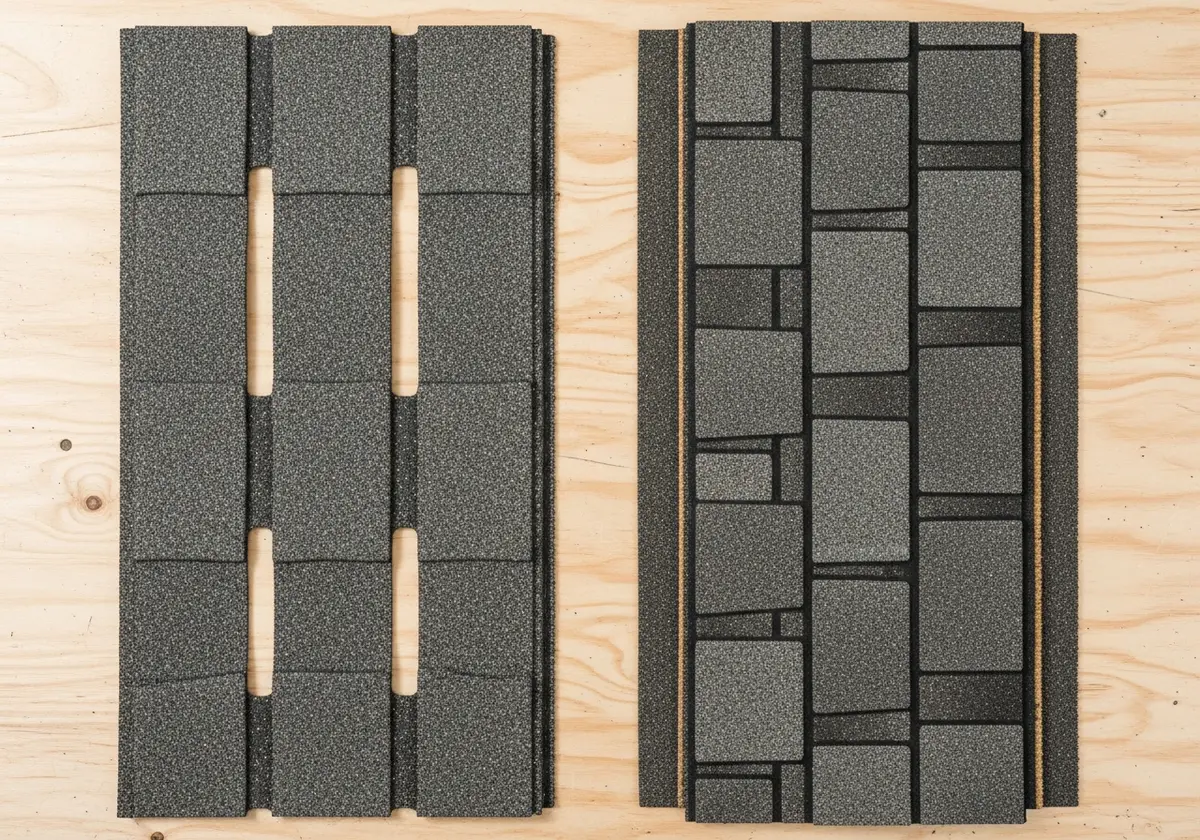
The three grades differ in more than price — they're built differently, and that difference is where the lifespan gap actually comes from. A three-tab shingle is a single flat layer of asphalt-saturated mat with a uniform pattern of tab cutouts: thin, consistent thickness, straight-line slots dividing each tab. An architectural (also called 'dimensional' or 'laminate') shingle is two layers laminated together in a staggered, irregular pattern with no cutout slots at all — that extra layer roughly doubles the material's thickness at the tab edge. The image below shows the two side by side; what reads clearly in a flat overhead photo is the pattern — slots and uniform tabs on one, a staggered, slot-free surface on the other — while the thickness difference is something you feel more than see, by picking up a strip of each. More material means more asphalt mat protecting the fiberglass base, a heavier shingle that resists wind uplift better, and a rougher, more dimensional surface that sheds hail impact differently than a flat one. Luxury or designer shingles push the same lamination approach further, often adding a third layer or a heavier mat weight, at a price that reflects appearance as much as durability. The 'manufacturer rating' column below is what's printed on the wrapper and covers manufacturing defects; the 'realistic service life' column is what these shingles typically deliver in the field before ordinary weathering — not a defect — ends their useful life. Work the two columns against each other on the grades where the wrapper carries an actual number and the realistic figure lands somewhere in the region of 60-85% of the rated one. In plain years the gap is widest where the rating is longest: a three-tab rated for 25 gives 12-18, a shortfall of several years, while anything sold on a 50-year rating tops out at 30-35, a shortfall of fifteen to twenty. There is no single conversion factor to memorise here, and any article offering you one is rounding harder than these numbers allow. The useful takeaway is directional: treat the figure on the wrapper as a ceiling you are unlikely to reach, not a forecast.
| Shingle type | Manufacturer rating | Realistic service life | Typical cost per square |
|---|---|---|---|
| Three-tab | 20-25 years | 12-18 years | $350 - $550 |
| Architectural / dimensional | 30-50 years (often marketed as 'lifetime') | 20-30 years | $500 - $850 |
| Luxury / designer | Lifetime (limited) | 30-40 years | $850 - $1,400 |
| Impact-resistant (Class 4) | 30-50 years | 25-35 years | $750 - $1,200 |
Why the same shingle lands at 20 years in Texas and 30 in Oregon
Manufacturer testing happens in a lab under controlled conditions. Your roof does not get that treatment, and where you live changes the outcome more than which grade of shingle you bought. Three climate variables do almost all of the damage. UV load is the biggest: intense, sustained sun drives the volatile oils out of the asphalt binder years faster than in a milder climate, leaving the shingle brittle and prone to cracking well ahead of its rated life. That is a large part of why climate, more than grade, decides where inside the 20-30 year band an architectural shingle actually lands: the same product that reaches the top of that band in the mild, overcast Pacific Northwest tends to sit near the bottom of it — around 20 years — under sustained Texas or Arizona sun. Freeze-thaw cycling does a different kind of damage: water that gets under a shingle edge or into a granule gap expands as it freezes, working the material apart a fraction at a time over hundreds of cycles each winter — this is why cold-climate roofs age from inside the material out, not just from surface UV. Hail frequency adds a third, more sudden failure path: each significant hail event bruises the mat and knocks granules loose in a pattern that's often invisible at first, and repeated storms compound rather than heal. A shingle rated for 25 years in a lab is really rated for 25 years in none of these conditions simultaneously.
Attic ventilation is the biggest thing you control
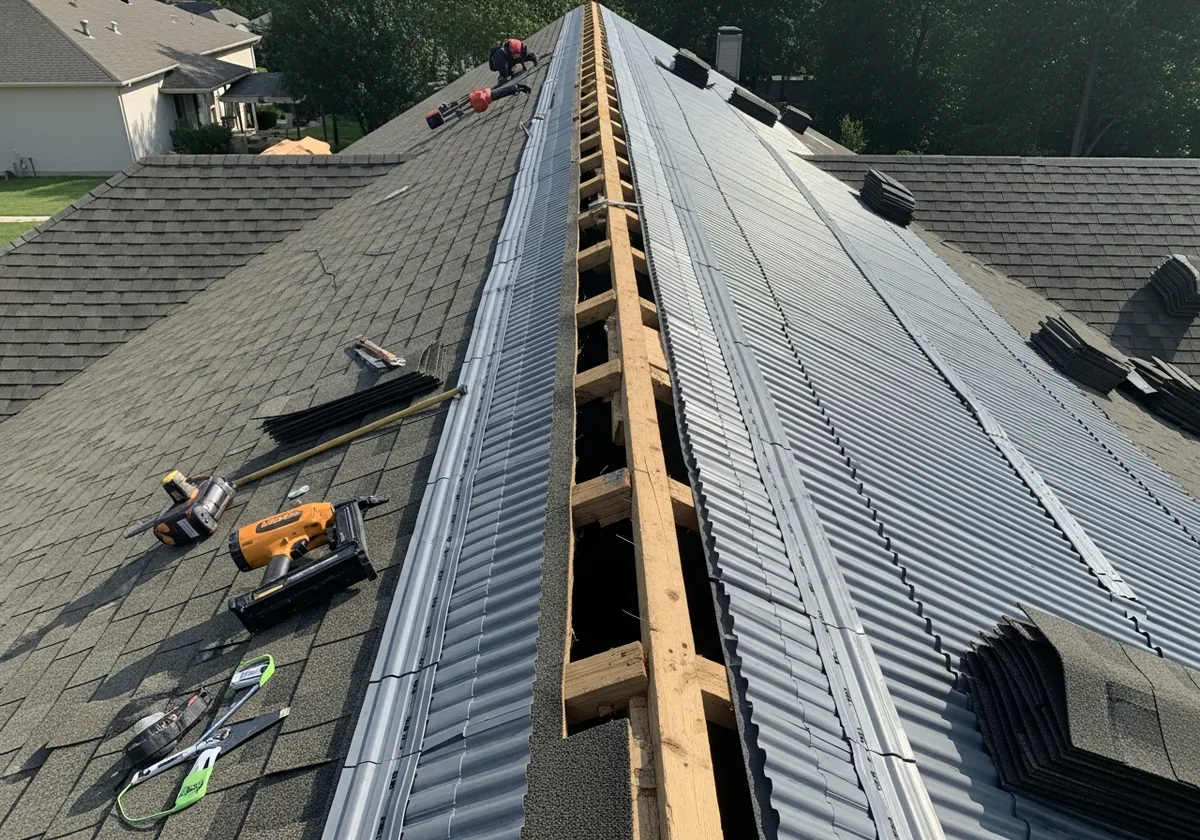
Climate is out of your control. Attic ventilation is not, and it's arguably the single biggest lifespan lever a homeowner actually has influence over. A hot, poorly vented attic bakes the underside of the roof deck all summer, which raises the shingle's own temperature well above ambient and accelerates the same UV-driven aging described above — a shingle rated for 25 years over a well-ventilated attic can lose several years off that figure sitting over a hot, stagnant one. Good ventilation works by continuously pulling cooler air in low, usually through soffit vents, and pushing warm, moist air out high, usually through a ridge vent, so the deck never gets a chance to build up heat. The image below shows a ridge vent during installation, before the cap shingles go over it — worth knowing, because a finished ridge vent is designed to disappear. Once the cap shingles are on, a continuous ridge vent and a plain, unvented ridge cap look identical from the ground; you genuinely cannot tell which one a house has just by looking up at it. If you don't know whether your attic has one, that's a question for a roofer doing an inspection, not something to check from the driveway.
Why a 30-year shingle is not a 30-year roof
The number printed on a shingle wrapper is a warranty term, not a lifespan prediction, and the two get conflated constantly. Most 'lifetime' or 30-50 year warranties are prorated after an initial non-prorated period — often the first 10 years — meaning that if a manufacturing defect shows up in year 20, you're entitled to a percentage of the original cost based on age, not a full replacement. Read as a curve rather than a cliff, the coverage that actually matters shrinks every year you own the roof. It also matters which warranty you are reading, because there are usually two and they behave differently. The standard limited product warranty comes with every bundle of shingles, applies whoever installs them, and covers manufacturing defects in the shingle itself — missing that manufacturer's registration window does not switch it off. The enhanced or system warranties sold on top of it — the ones marketed under names like Golden Pledge or Platinum — are the ones carrying real conditions: installation by a contractor the manufacturer has certified, use of that manufacturer's full system of underlayment, starter and ridge components rather than mixed brands, and registration inside a set window after the job. Miss any of those and what you lose is the enhanced coverage, including the workmanship portion, not the base product coverage underneath it. Both kinds still hinge on the roof having been installed to the manufacturer's instructions and adequately ventilated: a claim traced to a bad install or a baking, unvented attic gets denied on the grounds that the shingle was not the thing that failed. Terms differ meaningfully between manufacturers, so read the actual warranty document that came with your roof rather than a summary of one. None of this covers ordinary weathering, hail, or wind — ordinary aging is explicitly excluded from every asphalt shingle warranty, because it isn't a defect, it's the shingle doing exactly what asphalt does over time. The honest way to read a '30-year shingle' is as a shingle whose manufacturer expects a defect claim to be rare, not as a promise the roof will still be sound in year 30.