Lifespan by metal type
The metal itself isn't the only variable — fastener system, coating quality, and panel profile all factor in. Standing seam (concealed fastener) outlasts exposed-fastener panels by 15-20 years on average because the fasteners aren't exposed to UV and weather.
| Metal type | Lifespan | Cost installed (per sq ft) | Notes |
|---|---|---|---|
| Galvanized steel (exposed fastener) | 40-50 years | $7 - $10 | Fasteners typically fail before the metal |
| Galvalume steel (standing seam) | 50-70 years | $11 - $15 | Best value for longevity |
| Aluminum (standing seam) | 50-70 years | $13 - $18 | Coastal favorite — won't rust |
| Copper | 100+ years | $22 - $35 | Develops protective patina; outlives the structure |
| Zinc | 80-100 years | $18 - $28 | Self-healing patina; rare in residential |
| Stone-coated steel | 40-60 years | $10 - $14 | Looks like asphalt but lasts longer |
What actually fails first
On a standing-seam metal roof, the metal panels themselves rarely fail — they outlast the building. What fails is the rubber boot around plumbing penetrations (every 15-25 years), the sealant at end caps and ridge cap (every 20-30 years), and on exposed-fastener panels, the rubber gaskets under the screws (every 15-20 years, requires resealing or screw replacement). Plan maintenance budget around penetrations, not panels.
When metal pays back vs. asphalt
Standing seam metal runs to roughly double the installed price of architectural asphalt at the middle of each range ($13 vs. $6.75 per sq ft), and up to about three times at the extremes ($11-15 vs. $5.00-8.50 per sq ft). Whether that pays back is decided almost entirely by one variable: how long you will own the home. One worked example, used consistently here and in the cost section further down, on a 2,000 sq ft roof. Standing seam at $13 per sq ft — the middle of the $11-15 range in the table above — is about $26,000, on a 50-70 year service life. Architectural asphalt at $6.75 per sq ft is about $13,500, on a 20-30 year service life. Measured against the service life each one actually delivers, metal is the cheaper roof: roughly $430 a year against asphalt's roughly $540. Measured against a short ownership period, it is emphatically not, because you pay for six decades of roof up front and leave most of it behind when you move — sell after ten years and you have spent $26,000 to use about a sixth of the asset, against $13,500 to use around 40% of the asphalt one, and no resale market reliably refunds that difference. Two honest caveats on both figures: they are undiscounted, in today's dollars, with no inflation or cost-of-capital treatment, and metal's number ignores the boot and sealant maintenance covered in the section above, which is real money across 60 years even though it is nowhere near the cost of a reroof. Metal's non-cash advantages are separate from all of this and worth weighing: many carriers discount premiums for impact-resistant or non-combustible roofs — the amount varies by carrier and state, so ask yours rather than assuming a number — reflective coatings reduce attic temperatures, and a recent metal roof reads as transferable value to a buyer in a way a recent asphalt roof generally does not.
Where metal is the obvious choice
Metal makes the most sense in these scenarios. One common claim is worth correcting before the list, because it gets repeated everywhere: metal is not the only Class A roof. Fire ratings under ASTM E108 / UL 790 are assigned to a tested roof assembly, not to a bare material, and essentially every modern fiberglass-mat asphalt shingle sold in the US carries a Class A rating — the top one — in its tested assembly. A metal panel likewise earns its Class A as part of an assembly, and over a combustible deck it may need a specific underlayment or fire barrier beneath it to get there. The genuine difference is narrower than the marketing: the metal panel itself will not ignite, whereas an asphalt shingle's rating depends on a mat and asphalt that will burn if the assembly is breached. In a wildfire zone that difference is worth having, but check your local WUI code for what it actually requires rather than assuming the material settles it.
- You plan to own the home for 20+ years
- You live in a hail-prone area and have already replaced your roof more than once
- You're in a wildfire zone — the metal panel is non-combustible in itself, where asphalt's fire rating comes from the tested assembly around a mat that does burn
- You have a low-slope or flat roof where asphalt won't perform well
- You're building or remodeling — incremental cost is lower if you skip the asphalt step
- You want a 'forever roof' to remove that decision from your future
Standing seam, exposed fastener, stone-coated: three different lifespans
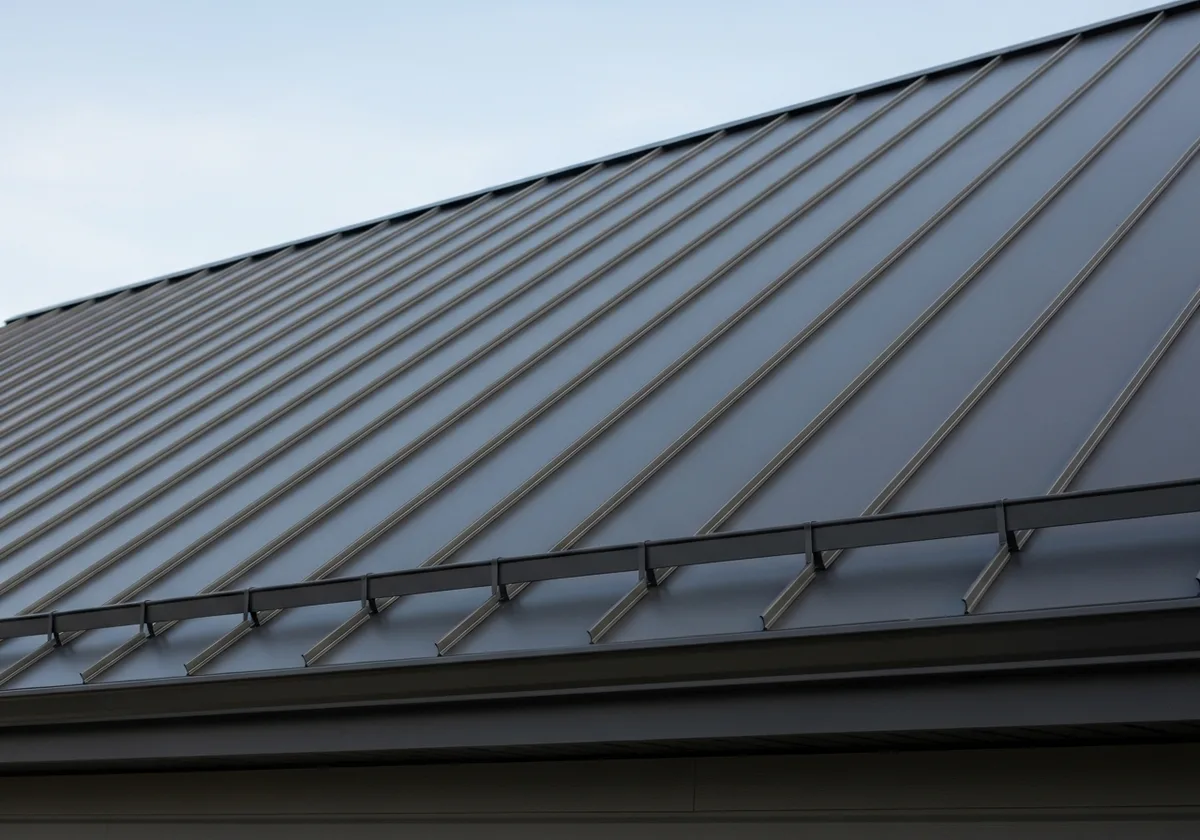
The fastening system matters as much as the metal itself, which is why the earlier table sorts by metal type but this one sorts by how the panels are attached — because that's the variable most homeowners actually get to choose. Standing seam uses concealed fasteners: clips hidden under raised, interlocking seams hold the panels down, so no screw head is ever exposed to UV, rain, or thermal cycling. That's the system shown in the image below — the raised vertical seams running the length of the panel are the interlock itself, not decoration. Exposed-fastener panels (often called 'ag panel' or corrugated metal) are screwed directly through the panel face, with a rubber washer under each screw head doing the sealing work; every one of those washers is a small, exposed rubber part sitting in direct sun for the life of the roof, which is the system's defining weakness. Stone-coated steel looks like asphalt shingle or tile from the ground — the steel panel is coated in a layer of stone granules bonded with acrylic — and inherits either a standing-seam or an exposed-fastener attachment underneath depending on the product, with the stone coating itself as an added, separate wear layer. Across all three, the panel metal typically outlasts whatever is fastening or coating it; that's the theme the next two sections dig into.
| System | Typical service life | Main failure mode | Relative cost |
|---|---|---|---|
| Standing seam (concealed fastener) | 50-70 years | Sealant/flashing failure at penetrations, not the panels | $$$ |
| Exposed fastener | 40-50 years | Washer degradation and screw backout | $ |
| Stone-coated steel | 40-60 years | Coating wear exposing the steel substrate | $$ |
The coating fails long before the metal does
On any painted or coated metal panel — which is most residential metal roofing — the finish is doing a job separate from the steel or aluminum underneath it, and the finish has its own, shorter clock. The coating (commonly a baked-on paint system or a granular stone coating) blocks UV from reaching the substrate and, on steel, helps prevent corrosion from starting at scratches and cut edges. Coatings chalk, fade, and eventually crack or peel with age, and once that happens the substrate underneath is exposed the same way an asphalt shingle is once its granules are gone. On steel panels specifically, a failed coating isn't just cosmetic — it's the point where rust can actually start, at cut edges, fastener penetrations, and any spot where the coating was scratched during installation or by debris since. Aluminum and copper don't rust — there's no iron in either to make rust — so a coating failure on those substrates is generally a slower problem than on steel. It is not a free pass, though, and 'doesn't rust' gets stretched into 'doesn't corrode', which is wrong. Bare aluminum forms its own protective oxide layer and often just weathers to a dull grey, but in salt air it pits, and it corrodes galvanically wherever it sits in contact with a dissimilar metal — copper flashing, a steel fastener, run-off from a copper gutter — which is exactly the coastal setting aluminum gets recommended for in the first place. Copper is the genuinely low-maintenance case: its patina is the protective layer. On aluminum, treat an exposed or breached coating near the coast as something to look at, not something to ignore. The practical upshot: a metal roof's real service life is usually set by how long the coating holds, not by any inherent limit of the steel or aluminum panel underneath it.
On exposed-fastener roofs, the screws are the clock
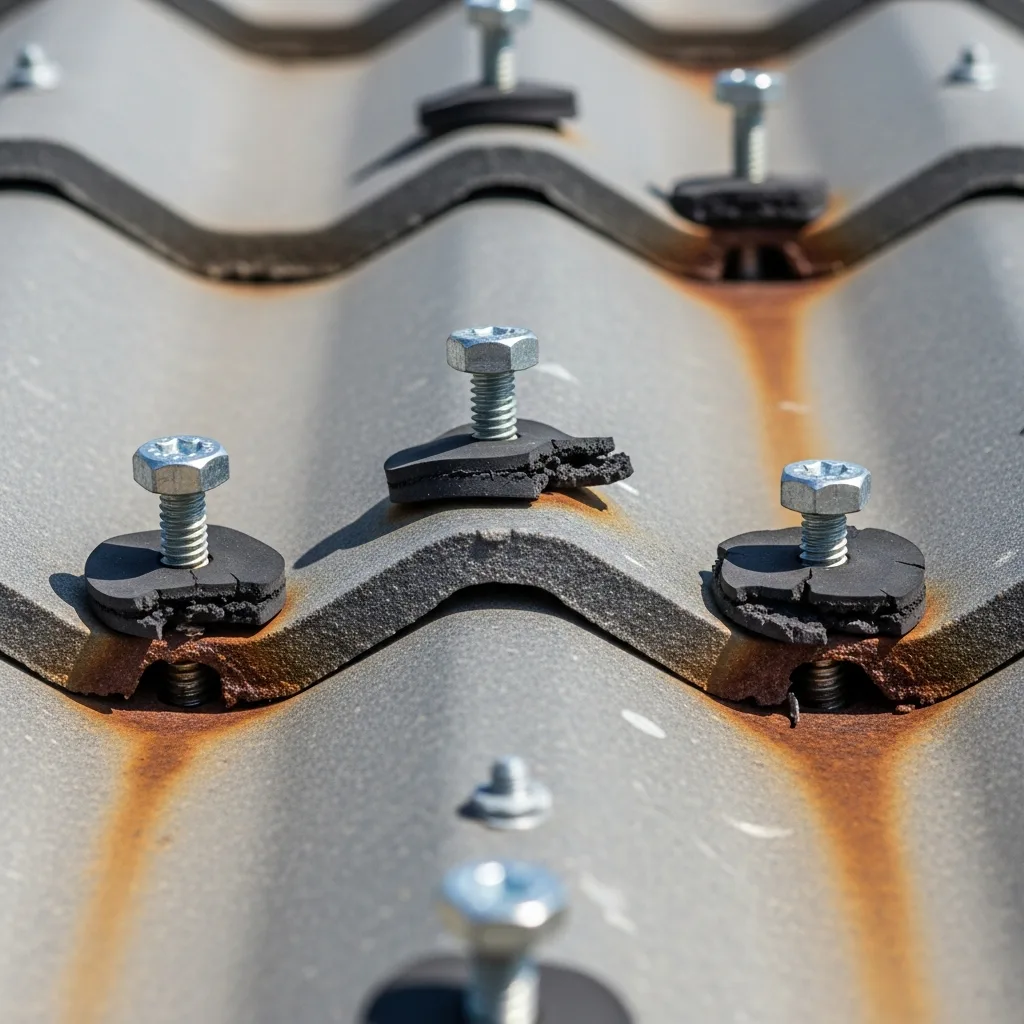
Every screw on an exposed-fastener panel is a small point of failure sitting in direct weather for the life of the roof, and there are typically hundreds of them across a residential roof. Each screw seats through a rubber washer that compresses against the panel to seal the hole. That washer is the actual weak point: UV and repeated thermal expansion and contraction — the panel heating and cooling faster than the screw does — work the rubber until it cracks, shrinks, or splits, at which point the seal is gone even though the screw is still physically in place. A cracked washer doesn't leak immediately; it leaks the next time wind-driven rain hits that spot from the wrong angle. Screws also physically back out over years of the panel expanding and contracting against them, which shows up as a slightly raised screw head standing proud of the panel surface — the image below shows both problems at once: cracked and split washers around backed-out screws, with rust already bleeding down from the holes. Most exposed-fastener roofs need a full re-screw or a resealing pass at the washers somewhere in the 15-20 year range, well before the panels themselves are anywhere near failure — budget for it as routine maintenance, not a surprise repair.
Metal versus asphalt over a fixed 50-year horizon
The section above ran the two systems against the service life each delivers. This one extends the same example to a fixed 50-year horizon, which is where the replacement schedules diverge. Same inputs: a 2,000 sq ft roof, standing seam at roughly $13 per sq ft for about $26,000 on a 50-70 year life, architectural asphalt at roughly $6.75 per sq ft for about $13,500 on a 20-30 year life. Every figure below is undiscounted and in today's dollars — no inflation, no cost of capital, and no attempt to price the fact that a dollar spent at year 25 is worth less than one spent today. Over 50 years the metal roof needs no replacement after the original install, but it does need maintenance: on the 15-25 year boot interval and 20-30 year sealant interval from the failure section above, that's roughly two to three service rounds across the horizon, each one a modest job against a reroof but not nothing, and it belongs in the total. The asphalt roof needs one full replacement at around year 25 and is approaching a second by year 50, putting its bare material and labour cost near $27,000 — plus its own repairs along the way, plus the incidental work twice over: gutters, landscaping, interior prep, each round. Count metal's maintenance and asphalt's second round of incidentals and the two land close to even on raw undiscounted dollars over 50 years. That is the same conclusion as the section above, seen from the other end: metal does not win on money, it wins on doing one roofing project in 50 years instead of two — and only if you are actually there for enough of that horizon to collect on it.