1. Granules in your gutters
Asphalt shingles are coated with mineral granules that shield the asphalt mat underneath from UV light. As the bond holding those granules weakens with age, ordinary rain works them loose and carries them into the gutters. A light dusting after the very first hard rain on a brand-new roof is normal — it's manufacturing residue shedding off, not wear. What matters after that is the trend: a handful of granules per downspout after every storm on a roof ten years or older usually means you're in its last three to five years. A cupful, or a visible bald patch where the black asphalt mat shows through on the shingle itself, means that spot has already lost its only UV protection, and replacement is closer to overdue than merely due. Check the base of every downspout after the next hard rain and compare it to what you found last time.
2. Curling, cupping, or clawing edges
When asphalt shingles dry out from years of UV exposure, the mat loses flexibility and the edges start to lift. Cupping is when the outer corners of a shingle turn upward, forming a shallow dish. Clawing is closer to the opposite — the middle of the shingle bows up while the edges stay pinned flat. Both are signs the shingle has lost the oils that kept it pliable, and both mean the seal between courses is compromised: wind can now get a grip under the lifted edge instead of sliding over it. A few curling shingles on an otherwise sound, younger roof can sometimes be addressed with a spot repair. Curling spread across a whole slope, especially the one that takes the most sun, is a wear-out pattern rather than a defect, and points toward replacement rather than patching.
3. Missing shingles
Wind progressively strips shingles off a roof as the adhesive seal and nail bond age past their working life. A single shingle torn off after an unusually strong gust, on a roof that's otherwise in good shape, is a straightforward repair — replace it and reseal the surrounding tabs. The picture changes once shingles are missing from more than one slope, or from several separate spots on the same slope: it means the sealant bond has failed broadly rather than just at the one spot that happened to go first, and the shingles still in place are likely to follow within the next storm season or two. At that point you're not really choosing whether to spend money on the roof, only when.
4. Sagging or wavy roof line — STOP, this is structural
If the roofline dips, sags, or reads as visibly wavy when you look at the house from the curb, something in the deck or the rafters underneath has lost its ability to hold a straight line — the shingles on top are cosmetic at that point, not the problem. Water damage is the most common cause but it is not the only one, and the cause changes the fix: rafters that were undersized or overspanned for the load when the house was built, two or three layers of shingles stacked on a deck rated for one, foundation or framing settlement pulling the structure out of line, or an outright error in the original framing will all produce the same visible dip with no rot involved at all. What every version has in common is that it is a structural question rather than a roofing one, and a deck or rafter that has lost enough strength can collapse rather than merely leak. Don't wait for a scheduled inspection. Call a roofer or a structural engineer promptly, and stay off that section of roof — including for photos — until someone has confirmed what's holding it up. The section further down this page walks through how to read this sign from the ground before anyone gets on a ladder.
5. Daylight in the attic
Go into the attic on a bright day, turn the lights off, and look up at the underside of the roof deck. Any point of daylight that isn't a vent, a plumbing stack, or a skylight is a hole — a place where the decking or its covering has failed completely. A single pinprick of light usually traces back to a small, fixable puncture or a nail that's backed out. Daylight visible in several places, or light coming through in patches rather than pinpoints, means the decking itself is deteriorating and a re-deck is likely part of whatever comes next, not just new shingles on top. The section further down goes into why this particular sign tends to settle the repair-or-replace question faster than any other.
6. Stains on interior ceilings
Brown rings or yellowish stains spreading across a ceiling or down an upper-floor wall mean water has been finding its way in for a while — the stain is just the point where it finally soaked through drywall far enough to show. Whatever you can see is downstream of a larger wet area in the insulation and framing above it, and that moisture doesn't dry out on its own once it's trapped between the deck and the ceiling. A single small stain that hasn't grown in months might trace back to a one-time event, like ice damming after an unusual cold snap. A stain that's spreading, or a second one appearing elsewhere, means the entry point is still active. Get a roof inspection within the next 30 days, ideally scheduled for the next dry stretch of weather so the roofer can actually see the deck.
7. Moss or algae across whole slopes
Thin, dark streaks running down a shaded slope are algae, and on their own they're cosmetic — unattractive, but not a structural signal. Moss is a different problem. A carpet of moss covering a meaningful share of a slope, usually the one that stays shaded and damp longest, holds water directly against the shingle surface around the clock instead of letting it run off, and that constant moisture works into the shingle mat and the decking beneath it. Once moss covers roughly a third or more of a slope, assume there's deck damage under it even if you can't see it from the ground, because moss doesn't establish that thoroughly without sustained moisture retention. Removing moss without addressing what's keeping that slope wet — usually shade and poor airflow — just buys a season or two before it returns.
8. Flashing failures
Flashing is the metal trim sealing the joints around chimneys, skylights, vent pipes, and anywhere two roof planes meet — and it fails on a different timeline than the shingles around it, usually well before them. The failure mode is rust, lifting, or a sealant bead that's cracked and pulled away, and any of the three creates a direct path for water at exactly the points where a roof was already most vulnerable. Flashing is also the single most common source of leaks on a roof that otherwise looks fine, because homeowners scan for damaged shingles and skip past the narrow metal strips entirely. If the shingles around a chimney or skylight are sound but the flashing is rusted or lifted, that's a flashing repair — a fraction of the cost of a full replacement — not a reason to replace the roof.
9. Roof age over 80% of expected lifespan
This is the math approach, and it matters even on a roof that still looks fine from the ground. If an asphalt shingle roof is past roughly 20 years old — about 80% of a typical 25-year service life — assume you're near end-of-life regardless of appearance, because insurers increasingly do. Carriers start denying storm claims as ordinary 'wear and tear' once a roof crosses this line, and any settlement that is approved gets steeply depreciated. A major hail or wind event on a roof this age tends to become a full replacement regardless of what you'd have preferred, because the damage assessment and the age assessment point the same direction. Replacing proactively, before that storm hits, means you choose the material, the contractor, and the timing. Waiting means an insurance adjuster's scope decides all three for you.
10. Energy bills creeping up
An aging roof gradually loses its thermal performance in ways that don't show up as a leak. The deck can warp slightly, soffit and ridge ventilation channels get blocked by debris and nesting material over the years, and attic insulation gets damp and compacted from minor moisture intrusion too small to notice as a stain. Each of those individually is minor; together they let more summer heat into the living space below and make the HVAC system work harder to compensate. This is the most overlooked sign on this list because homeowners reflexively blame the air conditioner rather than the roof above it. If summer cooling costs have been climbing year over year with no other explanation and the roof is old enough to be a candidate, it's worth having both looked at together.
Repair or replace: how to tell which one you're looking at
Every sign on this page eventually resolves to one of two questions: fix what's there, or replace the whole system. The table below is a fast reference for that decision, but three general rules cut through most of the ambiguity. First, scope: damage confined to one small area of one slope is usually a repair; damage spread across multiple slopes usually is not, because it means the whole roof is failing at roughly the same rate, not that one spot got unlucky. Second, source: surface wear — granule loss, curling, moss — is a materials-aging problem and scales with the roof's age; a single storm event is a damage problem and can strike a young roof just as hard as an old one, which is a different conversation with your insurer than ordinary wear. If the cause looks like hail rather than weathering, the visible signs are different again — bruised, dimpled mats rather than curled edges — and it's worth reading our guide on how to tell hail damage from wear before you call anyone. Third, structure: anything touching the deck or framing, not just the shingle surface, is never a simple repair.
| What you're seeing | Typical cause | Repair or replace | Urgency |
|---|---|---|---|
| A few granules per downspout | Normal aging, UV wear | Monitor — no action yet | Low |
| Curling limited to one slope | UV/heat aging | Repair or monitor | Low-medium |
| Missing shingles on multiple slopes | Wind, failed sealant bond | Replace | Medium-high |
| Sagging or wavy roofline | Deck or rafter damage — water rot, overloading (extra shingle layers), undersized/overspanned rafters, or settlement | Structural check first — the fix depends on which cause it is | High |
| Daylight through the decking | Deck failure or puncture | Replace, or major repair depending on spread | High |
| Rusted or lifted flashing, sound shingles | Localized flashing failure | Repair | Medium |
When a sagging roofline means structure, not surface
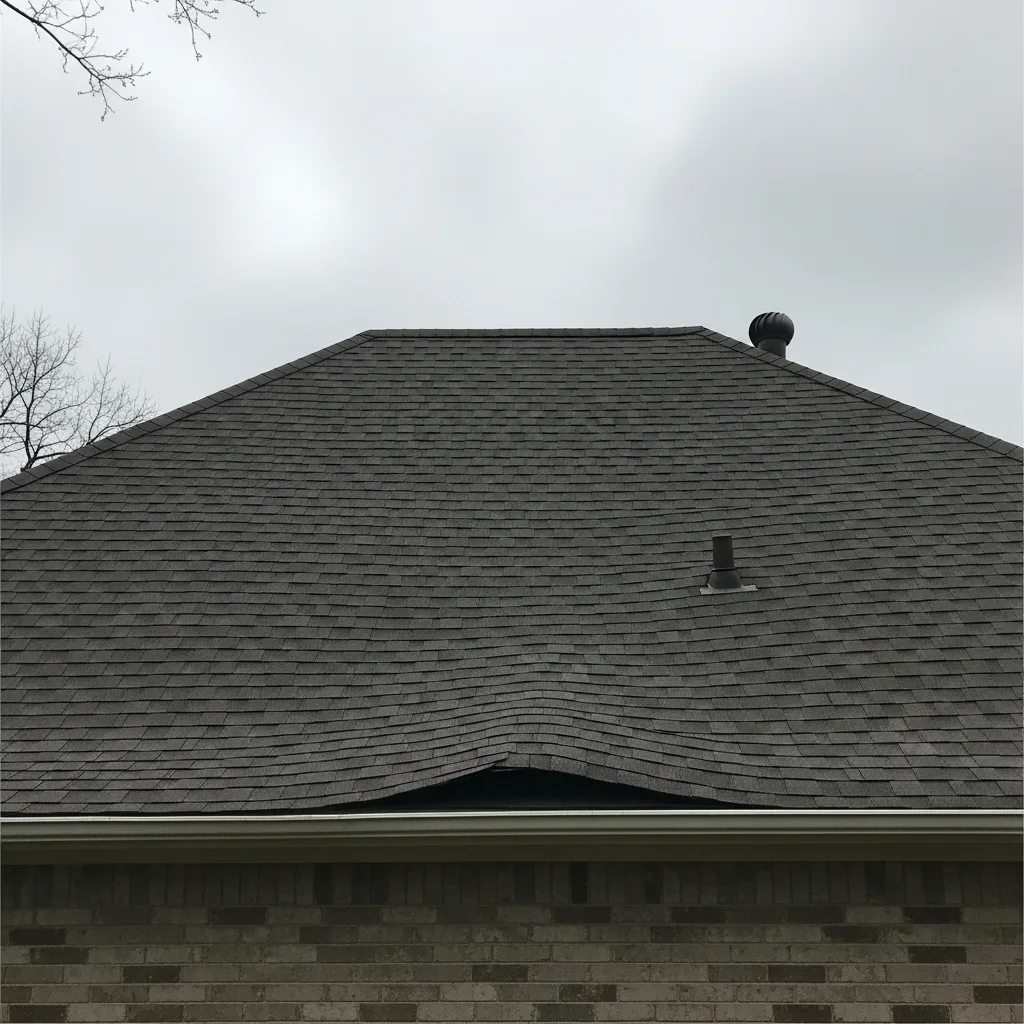
A sagging roofline is visible before you're close enough to see a single damaged shingle, which is exactly why it's worth learning to spot from the street. Stand across the road from the house and sight down the ridge line and the eaves — on a sound roof both should read as straight lines. A section that dips, bows, or ripples means the roof deck or the rafters beneath it have lost rigidity. The usual culprit is water — a slow leak that was never visible from inside because it tracked along a rafter before it ever reached a ceiling — but a roof carrying extra shingle layers it was never framed for, rafters undersized or overspanned from the day the house went up, or settlement moving the structure will all read the same way from the street, with no rot anywhere. You cannot tell which from the curb, and it matters: rot means replacing deck material, an overload or span problem means reinforcing or resizing framing, and settlement is a foundation conversation. The image below shows what that dip looks like from the ground: a visible wave in the shingle courses near the eave line, distinct from the flat plane on the rest of the roof. If you can see this from the curb, treat it as a call to a roofer or structural engineer today, not a line item for the next scheduled inspection.
Daylight in the attic is the one that ends the debate
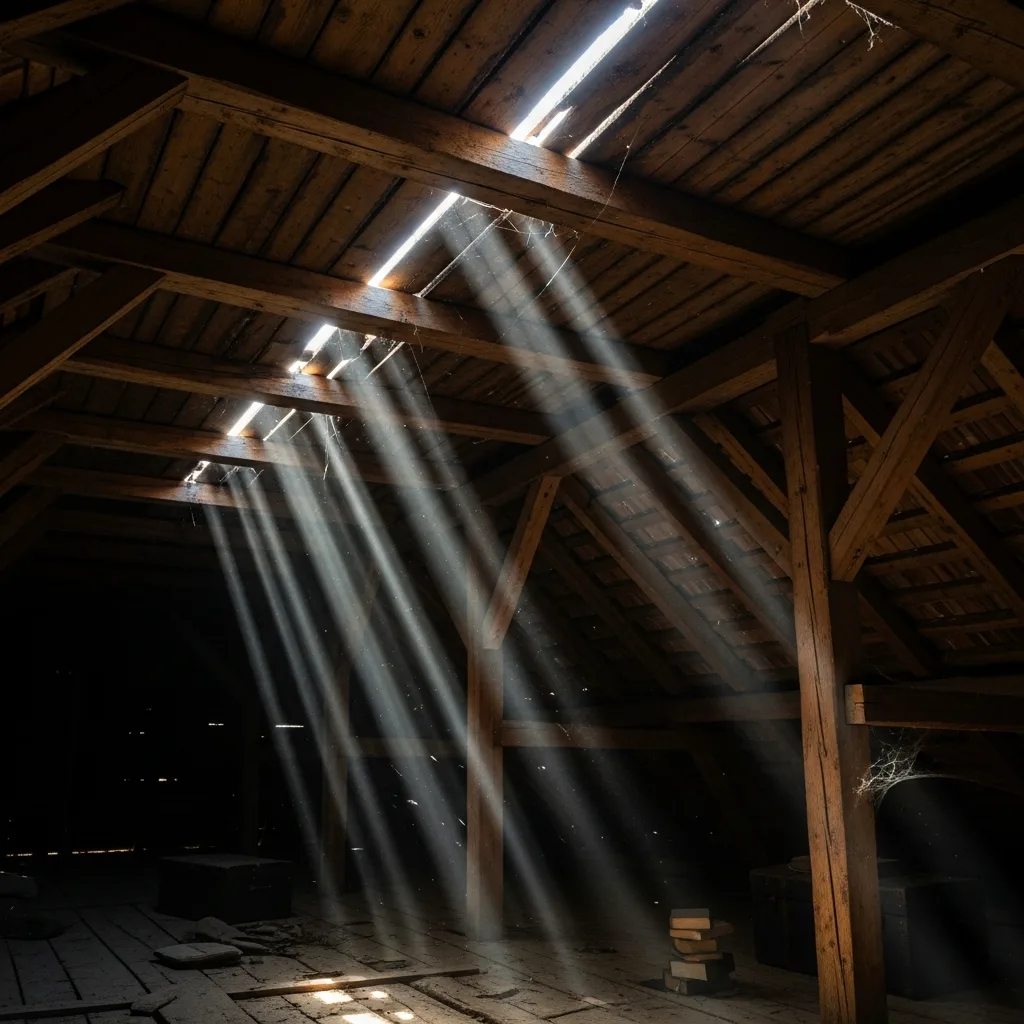
Of every sign on this page, daylight in the attic is the hardest one to argue with, because unlike granule loss or curling — both of which describe a gradual trend you could reasonably watch for another season — a hole is binary. Either light is coming through the decking or it isn't. Pick a bright, sunny day, turn off every light in the attic, and look up at the underside of the roof deck along its full length, not just near the access hatch. A single pinprick of light usually traces to a small puncture or a backed-out nail and is a targeted repair. Multiple points of light, or light coming through as a diffuse patch rather than a sharp point, means water has already been working on the decking around that opening for a while, and the deck itself — not just the shingles above it — is part of what needs replacing.
What a roofer will check that you can't see from the ground
Everything above is visible with your own eyes, which is useful for deciding whether to make the call — but it isn't the full inspection. A roofer walking the surface checks things a homeowner can't assess safely or at all from the ground: whether shingle tabs still hold a firm adhesive bond when lifted, or release easily, which predicts wind performance long before shingles start blowing off visibly. They probe the decking at valleys, around penetrations, and at the eaves with a moisture meter or an awl, since soft, spongy decking often sits under shingles that still look intact. They check nail placement — high nails or nails driven through the shingle above the adhesive strip are a common installation defect that shortens a roof's life regardless of material quality. And they check attic ventilation balance, since a roof with blocked soffit or ridge vents ages faster than an identical roof that breathes properly, independent of every sign listed above. Ask for these specifics on any inspection, not just a verbal 'looks fine.'