The short answer
There are five ways to date a roof, and they are not equally reliable — or equally easy. A building permit is the only one that yields a documented install date, which is why it leads this table. But permit access varies enormously by jurisdiction: some counties put every record online, others make you visit an office in person. If your county's portal is poor, skip to method 2 rather than grinding through it.
| Method | Difficulty | How accurate | How long it takes | Cost |
|---|---|---|---|---|
| Building permit | Easy to very hard — depends entirely on your county's portal | Exact date, if a permit was pulled | 10-30 minutes | Free |
| Closing / inspection documents | Medium — the work is finding the folder | Within about 3 years | 5 minutes | Free |
| Previous owner or HOA | Easy or impossible — you can't make them reply | Exact, if they kept receipts | Days (they have to reply) | Free |
| County assessor record | Easy where it exists — most records don't carry a roof year | Year only, often missing | 10-20 minutes | Free |
| AI estimate from satellite imagery | Easy | Rough estimate from visible wear | About 6 seconds | Free |
| In-person roofer inspection | Easy — you just have to book it | Within about 2-3 years | A scheduled visit | Free to ~$300 |
Why your roof's age matters
A roof's age is the single biggest factor in three decisions you will face: whether to file an insurance claim, whether to replace before selling, and whether to fight depreciation on a payout. Insurance carriers use age to set the depreciation schedule on every claim — on an actual-cash-value policy, a 15-year-old roof may be depreciated by half before a cheque is written. Realtors use it to set price expectations. Contractors use it to judge whether a repair is worth doing or whether you are spending money on a roof already past its warranty.
Method 1: Pull the building permit
This is the most authoritative source short of the original receipt, so try it first. Roof replacements above a threshold — typically $500 to $1,000 depending on jurisdiction — require a permit. Most US counties run a public permit search portal. Search your address, filter for 'reroof' or 'roof replacement', and the record shows the date pulled and the contractor of record. If a permit exists, you have a documented date rather than an estimate. Portal quality varies more than any other factor here: some counties return a full permit history from an address search in under a minute, others have no online record at all and require a written request. The state-by-state notes below are starting points, not guarantees.
- Texas — search your county appraisal district website
- Florida — Miami-Dade, Broward and Palm Beach all run free permit portals
- California — search your city building department (LADBS, SF DBI, and similar)
- Most other states — your county clerk or assessor's office
- No result is still information: it usually means the work was done without a permit, which matters if you are selling
Method 2: Check your closing documents
If you bought the home within roughly the last ten years, the inspection report from your purchase will estimate the roof's age. Pull your closing folder and find the 'Roof' line item in the inspection report. Inspectors estimate from material wear, so treat the figure as approximate — but it is fast, and it is written down, which matters if you later need to show an insurer what you knew and when.
Method 3: Ask the previous owner or HOA
If you are still in contact with the previous owner, ask — they may have the receipt, which beats every estimate on this page. If your HOA covers exterior maintenance, it will hold records of when units were re-roofed; email the management company and ask for the maintenance history on your address. This is slow because it depends on someone replying, but when it works it is exact.
Method 4: County assessor records
Property assessors note major improvements, including roof replacements, when those improvements change assessed value. Pull your property record card from the county assessor's website and look for a 'roof' or 'improvement' line carrying a year. It is less reliable than a permit because not every replacement triggers a reassessment, and the record is usually year-only. Useful mainly when no permit was pulled.
Method 5: A free AI estimate from satellite imagery
A roof shows its age from above. Our free report runs an AI vision model over current satellite imagery of your address and returns an estimated age, a condition grade and the likely material, read from what is actually visible — colour uniformity, streaking, granule loss and patching. It reads the roof; it does not pull permit or assessor records, so treat the number as an estimate rather than a documented install date. It is the fastest option here and the only one that works when no paperwork exists at all.
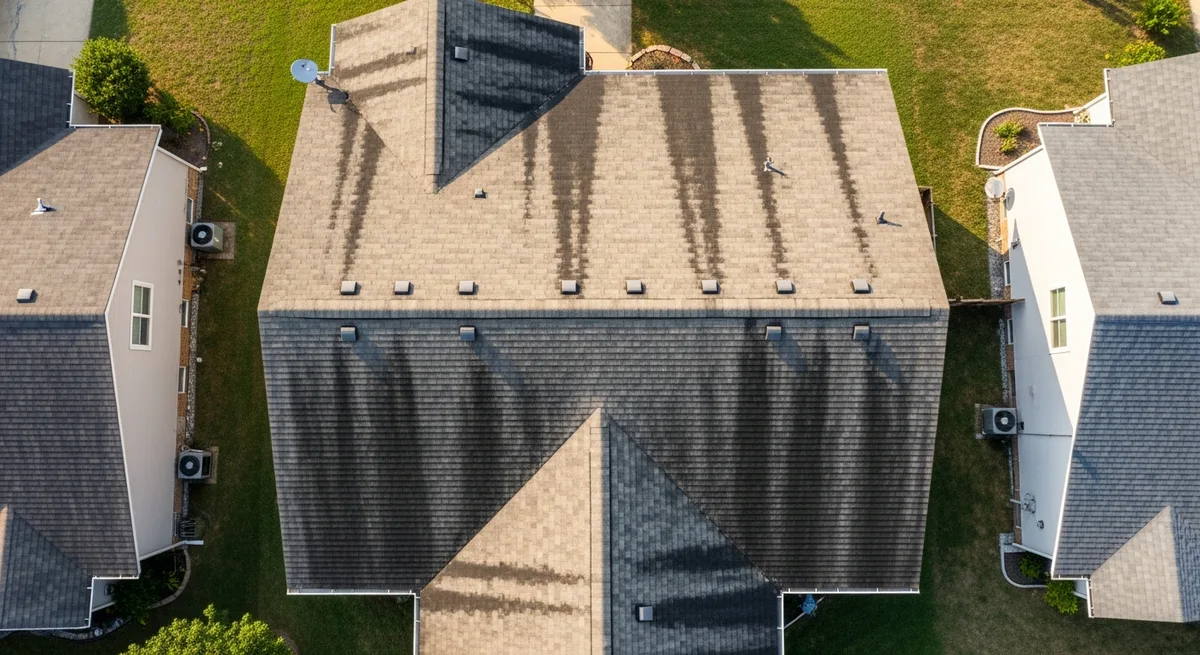
What the roof itself tells you, if you can see it
If you can view the roof safely from the ground with binoculars, or from an upstairs window, the surface gives you a rough age bracket on its own. These are the signs an inspector reads, in roughly the order they appear as an asphalt roof ages.
- Years 0-8 — uniform colour, sharp square tab edges, granules evenly distributed, no lifting
- Years 8-15 — slight fading, occasional dark streaking, a little granule accumulation in gutters
- Years 15-20 — visible colour mottling, granule loss showing darker patches, tab edges beginning to lift
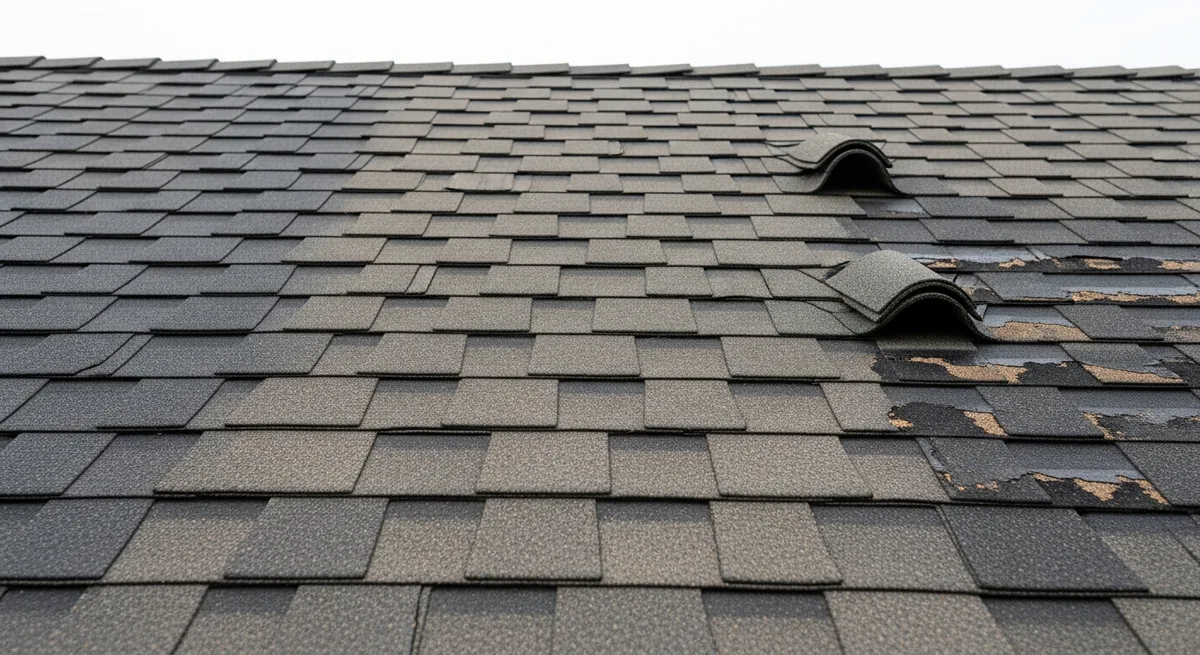
- Years 20+ — curling and cupping at the edges, cracked or missing tabs, exposed black mat where granules have gone, moss or lichen taking hold
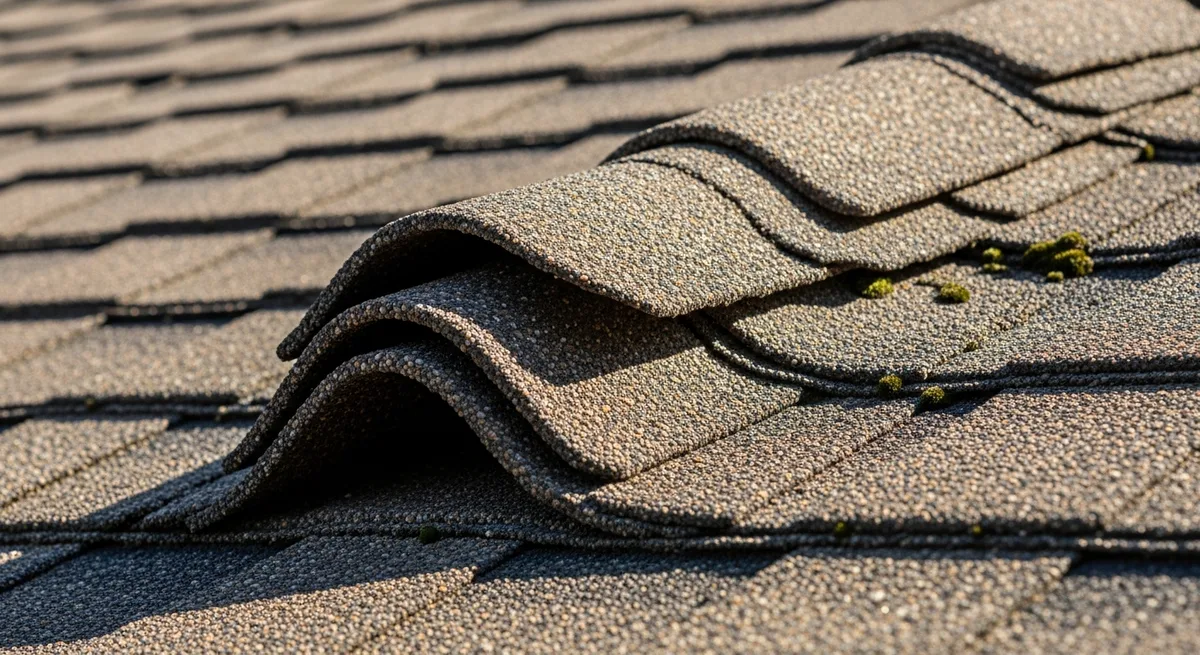
Granule loss is the clock
Asphalt shingles are protected by the mineral granules bonded to their surface. Those granules take the UV load; the asphalt underneath does not survive long without them. So granule loss is not cosmetic damage, it is the roof's clock running down. A handful of granules in the gutter after a storm on a new roof is normal shedding. Steady accumulation, bald patches, and darker areas where the black mat shows through mean the shingle is losing its only sun protection — and that the remaining lifespan is measured in a few years rather than a decade.
How long should it have lasted?
Once you have an age, compare it against what the material should deliver. These are realistic service lives in normal conditions, not the warranty printed on the wrapper — warranties are prorated and assume ideal ventilation and installation.
| Material | Typical service life | Notes |
|---|---|---|
| 3-tab asphalt | 15-20 years | The cheapest option and the shortest-lived |
| Architectural asphalt | 22-30 years | The default on most homes built since the 1990s |
| Impact-resistant (Class 4) | 25-35 years | Often earns an insurance discount |
| Wood shake | 20-30 years | Highly dependent on climate and maintenance |
| Metal standing seam | 40-60 years | Frequently outlasts the owner |
| Clay or concrete tile | 50+ years | Tiles outlast the underlayment beneath them |
Hot, sunny and storm-prone climates age roofs faster
The same shingle does not last the same time everywhere. Sustained UV and heat drive off the volatile oils in asphalt, making shingles brittle years earlier than the material rating suggests. Hail accelerates granule loss directly. Humid climates grow the algae responsible for the dark streaking visible from above. A 20-year architectural shingle in coastal Oregon and the same shingle in Phoenix or the Texas hail belt are not on the same schedule — expect the harsher climate to take several years off, and check the roof earlier than the number on the wrapper suggests.
What to do with the answer
Once you know the age, here is how it should change what you do:
- 0-10 years: inspect every couple of years. Any storm damage is worth claiming — depreciation is minimal.
- 10-15 years: inspect annually and start budgeting. Storm claims still pay well at this age.
- 15-20 years: the replacement window. Insurers begin questioning storm claims and pushing 'wear and tear' denials. A pre-storm replacement is worth pricing.
- 20+ years on asphalt: past warranty. Many carriers will not cover replacement, and some will not renew the policy at all without proof of recent work.
- Any age, after a major hail or wind event: get it looked at. Age determines what a carrier will pay, but damage determines whether you have a claim at all.