What an ice dam looks like from outside
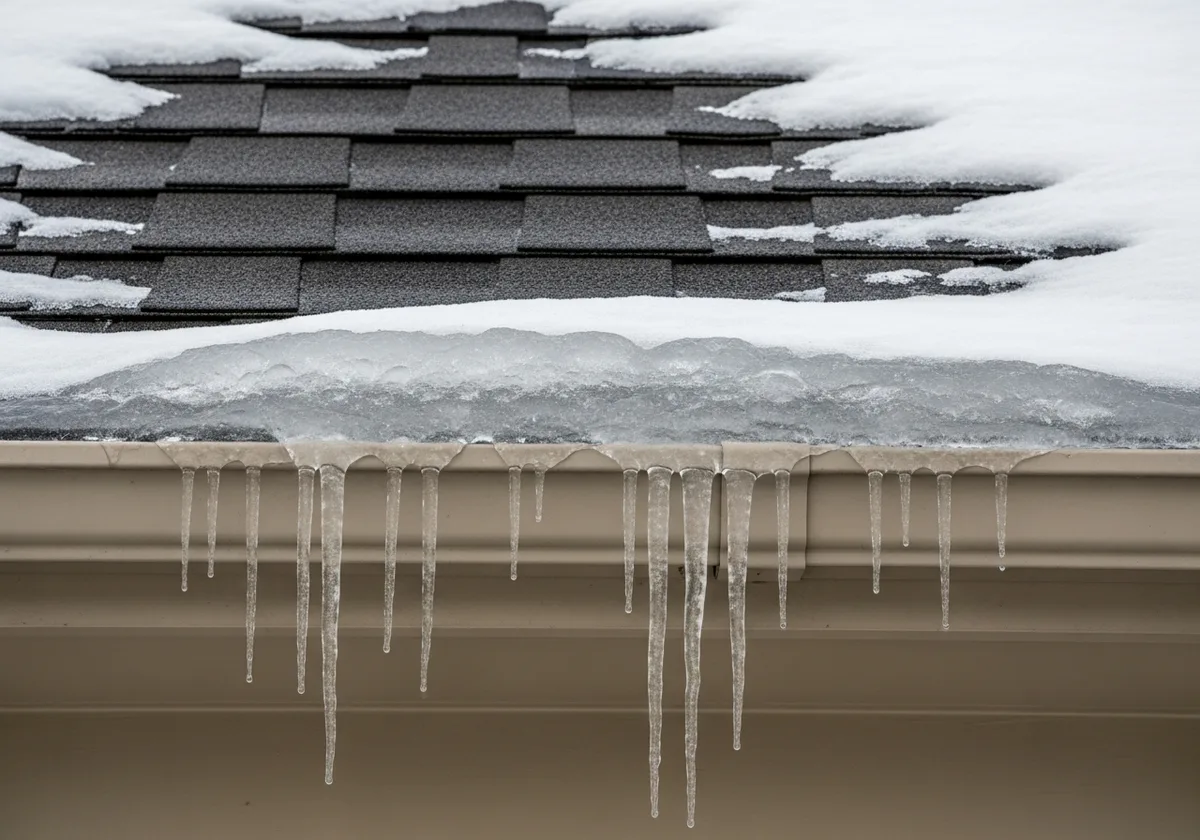
The visual signature is fairly consistent: a thickened ridge of solid, often cloudy-white ice sitting along the eave, usually right where the gutter is, with icicles hanging from the ridge or the gutter's lower edge. Snow above the ridge on the main roof slope may look normal, while the ice itself sits in a band that starts as a narrow lip at the edge and thickens into a broad, solid shelf after weeks of building. On its own, this tells you the melt-refreeze cycle is happening — it does not tell you whether water has actually gotten under the shingles. That's a separate question, and it's the one worth answering before you assume either 'it's fine' or 'it's a disaster.'
Interior signs: what to actually look for
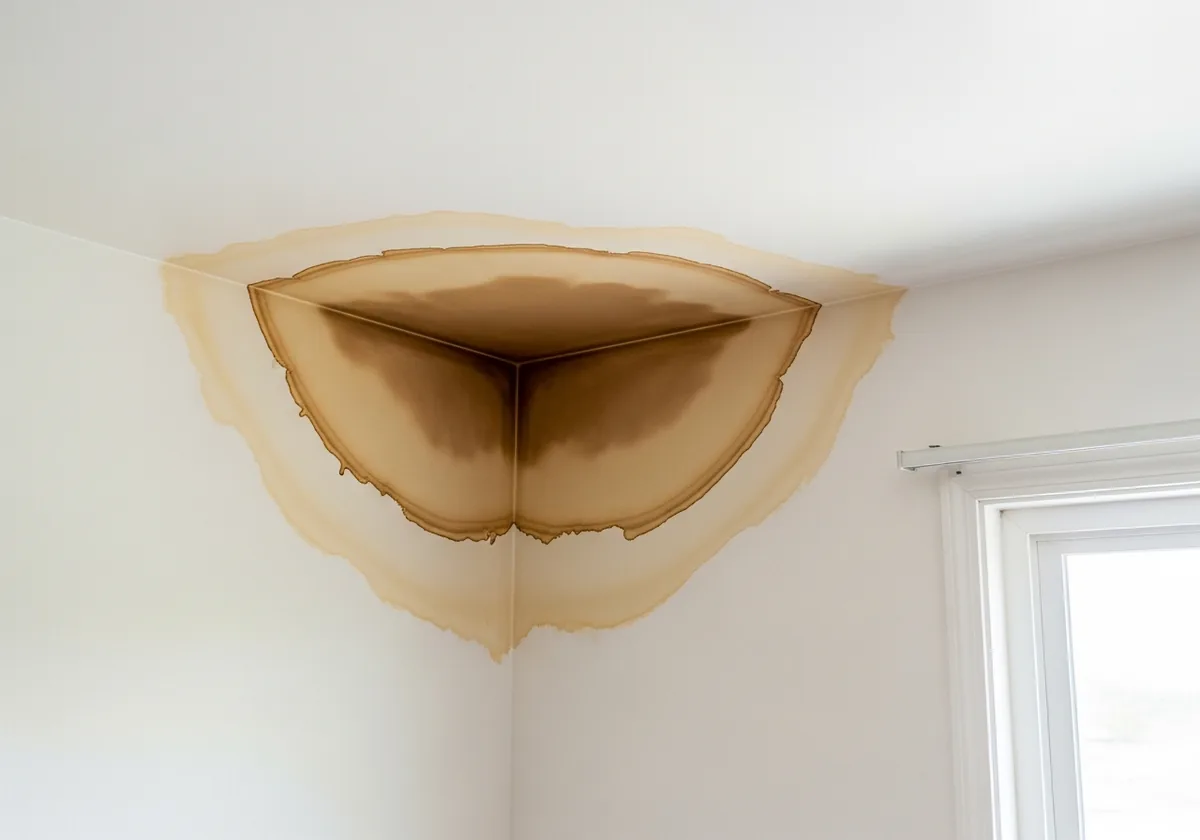
This is where the damage question gets answered, and the signs are usually subtle before they're obvious. Check ceilings and the tops of exterior walls, especially in rooms directly under the roof and near where you've seen ice building up outside, for any of the following:
- A discolored patch on the ceiling or upper wall — often yellowish-brown, sometimes just a faint darkening you'd miss without looking for it specifically
- Bubbling, peeling, or bulging paint or wallpaper on a ceiling or upper wall, which usually means moisture is sitting behind it
- A musty smell in a room or closet along an exterior wall, even with no visible stain yet — smell often arrives before a visible mark does
- Damp or discolored insulation if you can see into the attic near the eave, which is one of the earliest and most direct signs since it's closest to where water actually enters
- Water actively dripping, or a wet spot on the floor near an exterior wall, during or shortly after a thaw
Exterior signs beyond the obvious icicles
The ice ridge and icicles are the sign everyone notices, but a few other exterior clues are worth checking, especially because gutters carry a disproportionate share of the visible evidence:
- A gutter completely packed solid with ice rather than just holding a few icicles — this usually means meltwater has nowhere to go and is backing up rather than draining
- Ice sheeting down the siding below the gutter line, which suggests water is overflowing the gutter entirely rather than being contained by it
- Peeling or blistering exterior paint just below the eave, a slower-developing sign that repeated ice-dam seasons have kept that section of siding damp longer than it should be
- Ice visibly forming between shingle courses partway up the slope, not just at the very edge — a sign the dam has grown tall enough that meltwater is backing up well above the eave itself
Cosmetic vs. active leak — a quick read
None of this replaces a proper inspection, but it's a reasonable starting point for deciding how urgently to act.
| What you're seeing | Likely meaning | How urgent |
|---|---|---|
| Icicles and an ice ridge, nothing unusual inside | Normal ice-dam formation, not yet a leak | Worth monitoring; not an emergency |
| Gutter packed solid, ice sheeting onto siding | Water backing up with nowhere to drain | Check the attic and ceilings promptly |
| Faint ceiling discoloration near an exterior wall | Early-stage active leak | Get it looked at before the next thaw |
| Musty smell, no visible stain yet | Possible hidden moisture, often in the attic or wall cavity | Check the attic directly if you can access it safely |
| Bubbling paint, dripping water, wet flooring | Confirmed active leak | Address promptly — contain water and call a roofer |
Why the stain isn't always right under the ice
This trips people up more than almost anything else in this topic: water doesn't necessarily drip straight down from where it entered. Once meltwater gets under the shingles, it can travel sideways or downhill along the roof deck, the underlayment, or the top of the ceiling drywall before finding a gap to drip through — so a stain a few feet from where the ice dam sat outside is completely normal, not a sign you're looking at a second, unrelated problem. If you can safely access the attic, checking the sheathing and insulation directly, over as wide an area near the eave as you can see, is more reliable than trying to trace an interior stain back to an exact exterior point. It also means a single ceiling stain shouldn't be read as pinpointing exactly where the ice dam sat outside — treat it as evidence that water got in somewhere along that section of eave, and let a roofer or your own attic inspection narrow down the actual entry point, rather than assuming the stain marks the spot.
What to do the moment you spot a sign
None of these steps require climbing on a snowy or icy roof, which is exactly the wrong move regardless of how urgent the signs look.
- Photograph what you're seeing, inside and out, with the date — this matters for tracking whether it's getting worse and for any later insurance conversation
- If water is actively dripping inside, contain it with a bucket or towels. If drywall is visibly bulging with trapped water, a small controlled hole can relieve the pressure and prevent a larger collapse — but turn off power to that room first, since water sitting in a ceiling can reach wiring and light fixtures, and stand clear of directly underneath rather than beneath the bulge
- Don't chip or hack at the ice yourself from a ladder — it's a common way to damage shingles or gutters further, and it's genuinely dangerous work at height on ice
- Get a roofer or a company that offers steam-based ice dam removal to assess and safely clear it — steaming melts the ice without the impact damage that chipping causes
- Once things thaw out, get the roof and attic inspected properly rather than assuming the problem solved itself along with the ice
How this differs from a normal roof leak
An ordinary roof leak — a cracked flashing seal, a missing shingle, a failed pipe boot — tends to leak whenever it rains, regardless of temperature, and tends to show up in roughly the same spot every time for a fairly mechanical reason: there's a specific hole. An ice-dam leak is more seasonal and more intermittent. It shows up specifically during or right after a thaw, can appear to stop entirely once the ice melts off, and can shift slightly in location from year to year depending on exactly where that winter's dam built up and how big it got. If a 'leak' only ever seems to happen in cold weather and never during summer rain, that pattern is a reasonable clue you're dealing with a winter-specific cause rather than a hole in the roof. There are two main candidates, and they look nearly identical from inside: an ice dam, and attic frost — moisture from the house freezing on the underside of the cold sheathing all winter, then dripping through during a thaw. Both are cold-season only, both appear at a thaw, and both can move around from year to year. Telling them apart means looking in the attic, and the fix isn't the same: attic frost points at household moisture and ventilation rather than at the eave. It's worth describing the pattern to a roofer or insulation contractor and letting them make that call rather than assuming which one you have.
When it's more than cosmetic
A single, minor, well-documented ice-dam event with no interior signs is usually just that — an ice ridge that came and went. What turns it into a bigger problem is repetition and time: insulation that gets wet usually has to be replaced — blown cellulose mats down and never fully regains its loft, and any insulation that stayed damp long enough is a mold and contamination problem regardless of type. Until it's replaced, that section of ceiling is losing more heat than it should, which can make the next winter's ice dam worse rather than better. Sheathing and framing that stay damp repeatedly, rather than drying out fully between events, are at real risk of rot over several seasons. And any wall or ceiling cavity that stays damp for an extended period is a mold risk worth taking seriously, especially in a closed-up house through the rest of the winter. None of that is a reason to panic over a single season's icicles — it's a reason to actually get a professional to look once you've seen a genuine interior sign, rather than assuming it'll dry out fine on its own every time.