Why there's no single 'safe' number
Roofs are engineered to a load requirement set by the local building code at the time they were built, and that requirement is calibrated to the snow that region actually expects to see — a house built to a code written for a heavy-snowfall region carries a materially different design load than an identical-looking house built to a code written for a place that rarely sees snow at all. Roof age, the specific framing design, any past modifications like a converted attic or a removed interior wall, and even how the load requirement was interpreted at the time of construction all factor into what a specific roof was actually built to carry. That's why this article won't give you a pounds-per-square-foot figure and call it a fact — the honest answer is that your roof's number lives in its own engineering, if it was documented at all, and general guides can't responsibly stand in for that.
Wet snow vs. dry snow — why weight matters more than depth
The same depth of snow can represent very different amounts of weight sitting on your roof, and depth alone is a misleading way to judge risk. Fresh, cold, powdery snow is mostly trapped air and comparatively light for its size. Wet snow, snow that's been rained on, or snow that's gone through repeated freeze-thaw cycles and compacted into a denser, sometimes icy layer, can be dramatically heavier for the same depth. A foot of fresh powder and a foot of wet, settled, partly-refrozen snow are not remotely the same load on the structure, even though they look similar from the ground. That's the practical reason a roof that shrugged off an early, cold, powdery snowfall can be under real stress from a much shallower layer of heavy, wet snow later in the season — and why 'it handled more snow than this before' isn't a reliable way to judge the current situation if the snow type has changed.
Warning signs of a roof under stress
These are the signs worth acting on immediately, not monitoring over a few days. None of them are subtle once you know to look, and several are things you'd notice without even going outside.
- A visibly sagging roofline or ridge, especially a dip that wasn't there before this winter
- New cracks in interior ceilings or the walls near the roofline, or existing cracks that are visibly widening
- Doors or windows on upper floors suddenly sticking or becoming hard to open, which can mean the frame has shifted slightly under load
- Popping, cracking, or creaking sounds from the ceiling or roof structure, particularly sounds that are new or louder than usual
- Sagging or bowing visible in a garage, porch, carport, or other lighter-framed structure attached to or near the house — these are frequently the first to show stress because they're often built to a lighter load than the main house
- Bowing or bulging in an interior ceiling, which can precede a crack becoming visible
When to clear snow — and when not to
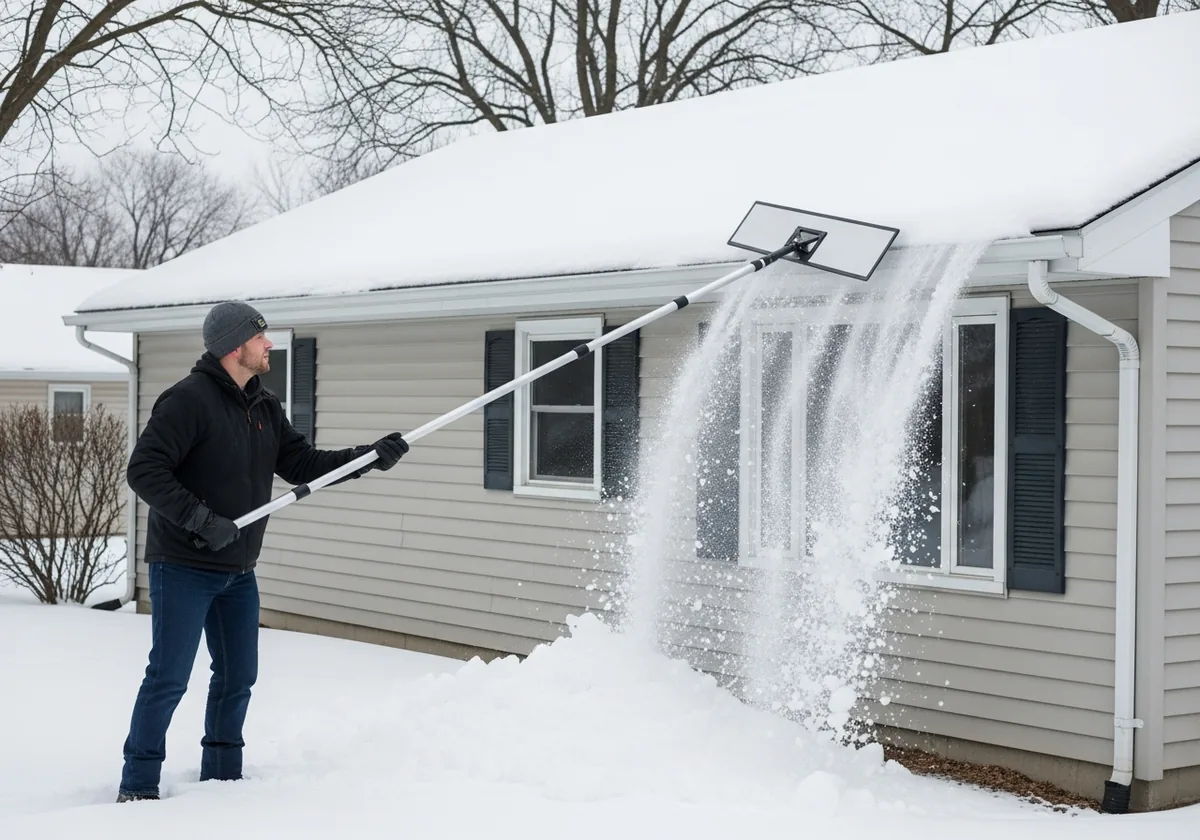
Routine snowfall on a sound, properly pitched roof usually doesn't need to be cleared — that's what the roof was built for, and getting up there unnecessarily is its own risk. Clearing becomes worth considering after an unusually heavy snowfall, especially wet or rain-soaked snow; after several storms have piled up without a real thaw in between; or over flat and low-slope sections, which hold snow far longer and more completely than a steep pitch that sheds naturally. For anything reachable from the ground, a roof rake used along the lower few feet of roof is the safest thing a homeowner can do — but be clear about what it actually buys you. Snow at the eave sits almost directly over the bearing wall, so clearing three or four feet at the bottom of the slope removes very little of the structural load, which is carried mostly by the snow higher up. Raking is an excellent ice-dam control and a poor snow-load control. If the worry is the structure rather than the ice, that's a call to a professional, not a job for a rake. For anything that would require actually getting on the roof, that's a job for a professional with the right equipment and safety gear, not a homeowner with a shovel and a ladder; falls from roofs are a real and common winter injury, and the weight reduction from clearing one section yourself rarely justifies that risk.
Which parts of a roof carry more load than others
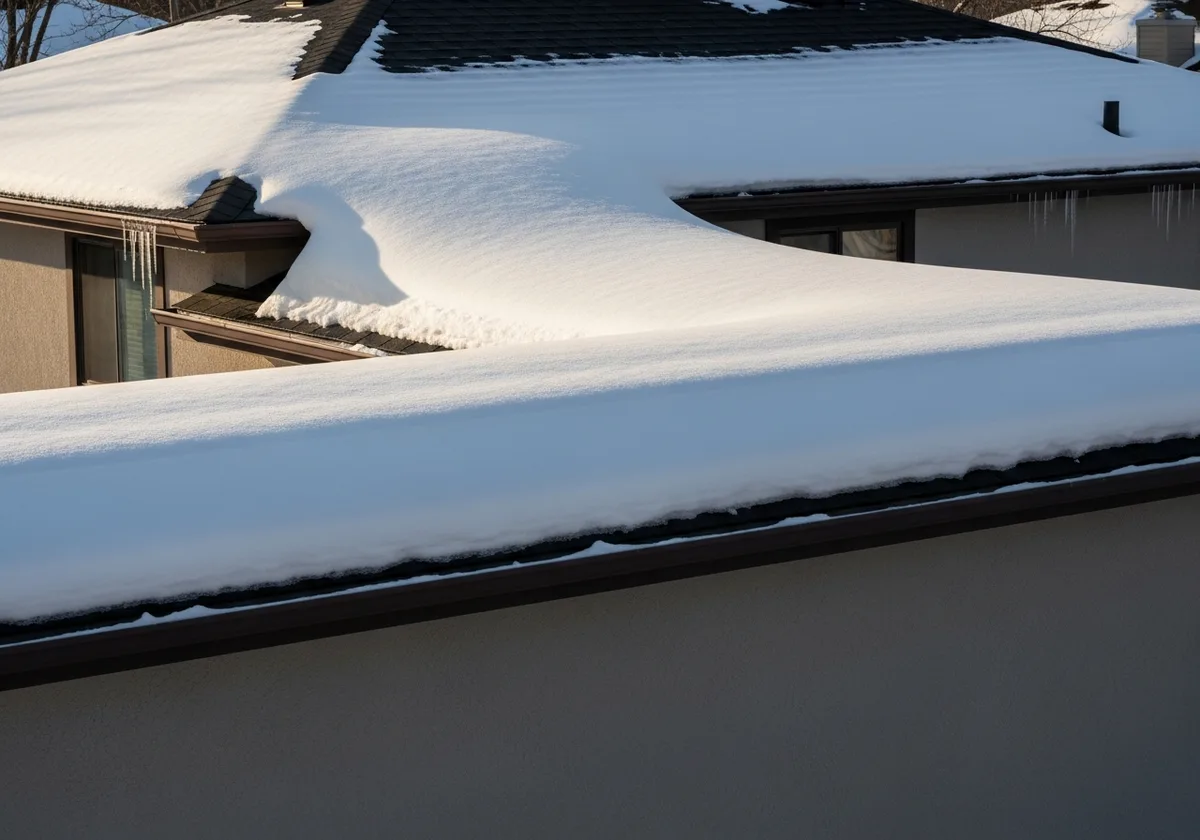
Snow doesn't distribute evenly across a roof, and load risk concentrates in predictable places. Valleys collect drifting and sliding snow from both adjoining slopes. Any spot where a taller section of roof meets a lower one is a drift zone, because wind and sliding snow from the upper roof pile up against the step rather than spreading out. Low-slope and flat sections — porch roofs, some additions, garage roofs — hold snow more completely than a steep main roof, both because less of it slides off and because these sections are sometimes framed to a lighter standard than the primary structure. If you're going to focus attention anywhere, these are the spots worth checking first after a heavy or repeated snowfall.
What a structural check actually involves
If you're seeing genuine warning signs — sagging, new cracks, sticking doors, unusual sounds — this isn't something to resolve by guessing or by clearing snow and hoping it helps. A structural engineer or an experienced contractor familiar with your local framing conventions can assess the actual condition of the roof structure: the framing members, the span, and whether any past modification changed how load moves through the building. That's a different and more thorough job than a general roof inspection, and it's the appropriate next step once you've seen an actual sign of stress rather than just a lot of snow.
Older homes and additions carry more risk
A few categories of structure are worth extra attention specifically because they're more likely to be carrying less margin than the main house. Homes built under older codes, before current design standards were adopted in your area, may have less load capacity than a home built more recently to the same footprint. Additions, sunrooms, and converted spaces are sometimes framed lighter than the original structure, particularly if they were built as a lower-cost addition rather than to match the main house's structural specification. Attached carports and porch roofs are frequently the lightest-framed structures on the property and often show stress first, even when the main roof is handling the same snowfall without any issue at all. None of this means these structures are unsafe by default — it means they're the ones worth checking first when conditions get unusual.